AI-powered recruiting software
AI that finds candidates.
Not AI that just filters them.
Most "AI recruiting tools" are keyword filters with a chatbot. Yena uses vector matching — semantic understanding of careers, skills, and potential. The difference between finding the right person and finding the right resume.
SOC 2 Type IGDPR Article 22 compliantEU AI Act ready
my.yena.ai/jobs/cfo-berlin-q2/shortlist
Vaga LinkedIn · importada agora
Chief Financial Officer — Berlim
Briefing analisado
Sinais ponderados
10 nomes ordenados
Pronto em 4.2s
1
Dr. Anna Weissmann| N26E-mail verificado
PorquêLiderou Série A→D na N26; €900M angariados em mercados regulados da UE. Preparação IFRS + SOX.
96
2
Lukas Brenner| HelloFreshContacto direto
PorquêVP Finance numa scale-up de consumo cotada. Experiência prática em vendas secundárias PE.
93
3
Sophie Hartmann| VolocopterColocado em 2024
PorquêIntensidade de capital deep-tech. Alemão nativo, fluente em negociações de fundraising.
91
4
Elena Rossi| Scalable CapitalAberto a contactos
PorquêCorretora regulada. Trilingue. Liderou anteriormente planeamento pós-Série D.
86
Most "AI recruiting" is marketing.
Chatbots that frustrate candidates. Keyword filters rebranded as machine learning. Black-box decisions that violate Article 22. Bias baked in from historical data. The "AI ATS" market is full of products where the AI is a thin layer on a 2015 database. You deserve to know the difference.
Chatbots that screen candidates with yes/no questions — then ghosting them
Keyword matching sold as "AI" — misses 60% of qualified candidates
Bias inherited from historical hire data — amplified at scale
Black-box decisions with no rationale — an Article 22 liability
Semantic matching, not keyword filtering
When a job spec says 'senior product manager with enterprise SaaS experience', keyword ATS looks for those exact words. Yena's vector matching understands the meaning — surfacing candidates who 'led cross-functional product launches for B2B software companies' even when zero keywords overlap. The difference matters most for senior roles where the right person rarely writes their CV the way you'd write a job brief.
See how vector matching works"We stopped filtering by keywords months ago. Yena finds people our keyword searches would've buried. It found our VP of Engineering from a database of 4,000 candidates in under a minute."
Tobias R. — Engineering Manager, B2B SaaS, Munich
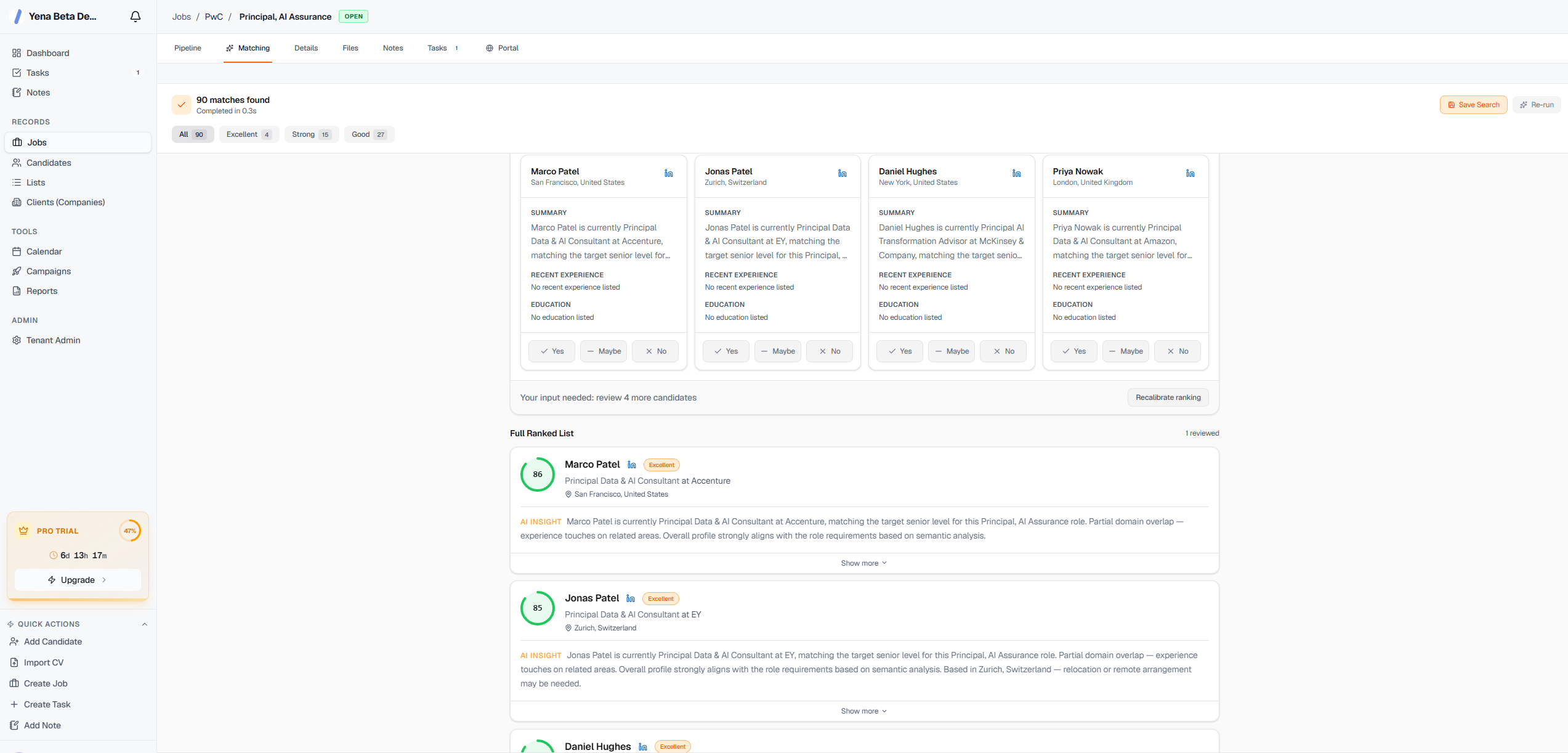
Search 10,000 candidates in 0.3 seconds.
Transparent enough to explain every single one.
Speed without sacrifice
Vector search across your entire candidate database takes milliseconds. Not because we're skipping checks — because the vectors are pre-computed and the math is fast.
Explainability built in
Every match shows its reasoning. Skill overlap, experience alignment, gaps flagged explicitly. Not because we're legally required to (we are) — because opaque AI creates bad hires.
You set the criteria
Adjust weighting per role. Prioritise sector experience over years of experience. Or leadership scope over technical depth. The AI adapts to your brief, not a generic template.
Your existing candidate data.
Searchable by meaning in 24 hours.
We migrate your current ATS data, re-index everything with vector embeddings, and run both systems in parallel until you're confident. No disruption to live searches.
Free data migration from any ATS or spreadsheet
All historical candidates become semantically searchable
AI onboarding — guided setup for your first vector search
GDPR consent flags preserved through migration
"We had 6 years of candidate data sitting in our old ATS doing nothing. Yena indexed it overnight. Within the first week, we filled two roles from candidates who'd applied for something else entirely — the AI found the connection we never would have made manually."
Kristīne B.
Managing Partner, Executive Search, Riga
EU AI Act ready. GDPR Article 22 compliant. Auditable by design.
SOC 2GDPREU HostedRBACAudit LogsSSO
Frequently asked questions
Every CV and every job description gets converted into a mathematical representation — a 'vector' — that captures meaning rather than just words. The AI then measures how close two vectors are. Close = semantically similar experience. A candidate who 'scaled a product team from 3 to 40 engineers' is close to a brief asking for 'senior engineering leader with team-building experience' even if those phrases share no words. Traditional keyword ATS would miss this candidate. Vector matching finds them.
Keyword matching is ctrl+F applied to a database. It finds candidates who used the exact words in your job description. Vector matching understands context — synonyms, related concepts, implied skills. It also understands what's missing. A CV heavy on technical depth but light on people management will match a senior IC role better than a VP role, even if neither brief mentions 'individual contributor'. That nuance is invisible to keyword systems.
Yes, it can — if built carelessly. AI trained on historical hiring data inherits historical biases. We don't train Yena's matching on your historical hires precisely to avoid this. The vector model is trained on language understanding, not on 'people who got hired here before'. We also surface the matching rationale so you can check what the AI weighted, and override it. The EU AI Act classifies AI recruitment tools as 'high risk' — which means transparency and human oversight aren't optional. We built for that from day one.
Article 22 gives individuals the right not to be subject to solely automated decisions that significantly affect them — and the right to an explanation when they are. Yena provides exportable rationale for every AI ranking. Human recruiters make the final shortlisting decision. The AI ranks and recommends; it doesn't reject. You can configure candidate-facing communications to explain that human review occurs. Data is EU-hosted, consent workflows are built in, and retention policies are configurable per jurisdiction.
Professional and technical roles where career history is meaningful — executive search, engineering leadership, commercial directors, finance, legal, specialist technical. It's less useful for high-volume early-career hiring where volume processing is the challenge, not semantic matching. If you're screening 800 barista applications, keyword filtering plus a structured test is probably more efficient than vector matching. If you're finding a CFO for a Series C FinTech, vector matching is genuinely different.
No minimum database size. Vector matching works on a database of 10 or 10,000. Smaller databases just return fewer results — the quality of matching doesn't degrade. Where it compounds in value is for retained search firms and in-house teams with years of candidate history. Those 3,000 candidates who applied 18 months ago? Yena can re-rank them against a new brief in under a second. Most teams find their first AI-surfaced hire from their existing data within the first two weeks.
Want to understand AI matching before you buy?
How vector embeddings work in recruiting — and the questions to ask any vendor claiming to use AI.
Read the AI recruiting guide