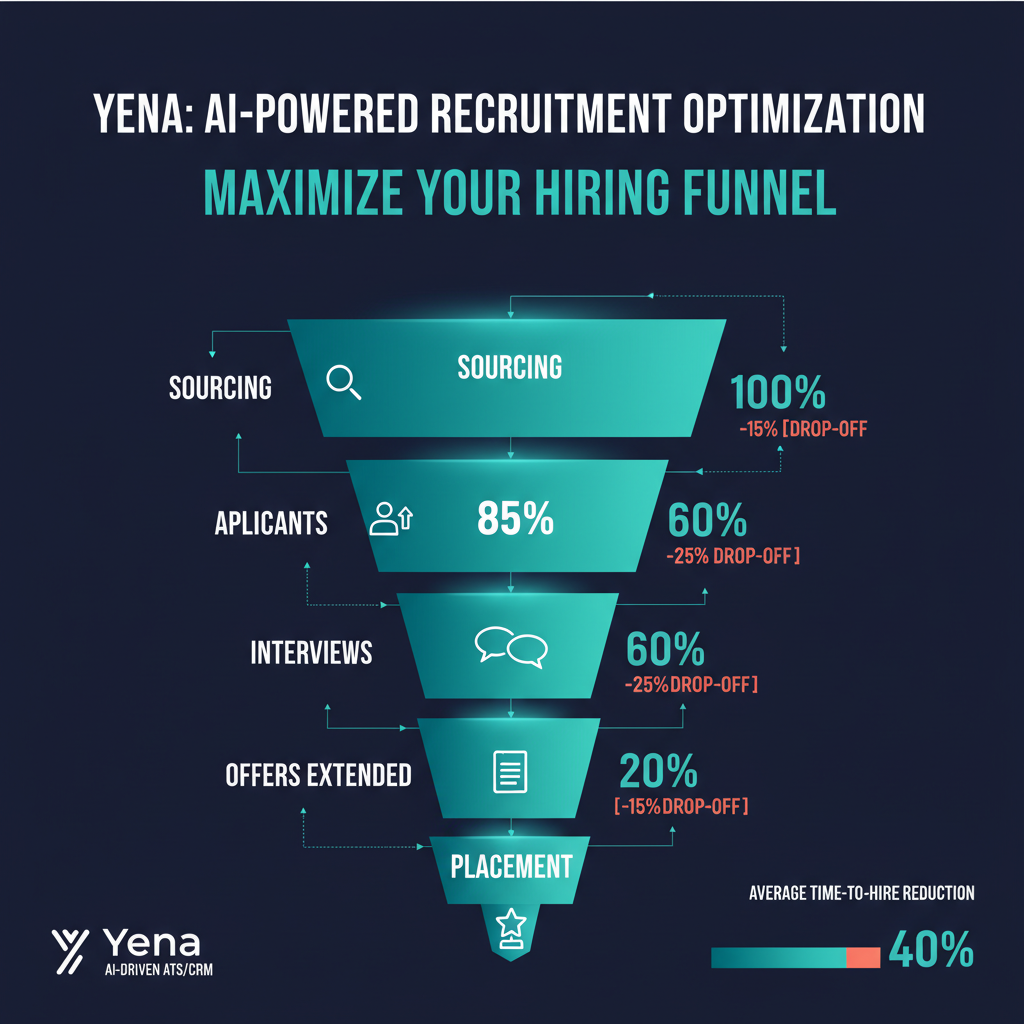
I've watched recruitment agencies celebrate "record sourcing months" whilst their bank accounts stay stubbornly flat. They've got 400 candidates in the pipeline, 12 active clients, and somehow can't close enough deals to justify the headcount.
The culprit isn't lack of candidates. It's pipeline velocity — or rather, the complete absence of it.
SaaS companies live and die by conversion funnel metrics. If 100 people visit your pricing page and only 2 sign up, you've got a 2% conversion rate and you bloody well know it. You measure it. You optimise it. You A/B test the button colour.
Recruitment agencies? They're flying blind. Most can't tell you how many candidates drop out between "submitted" and "first interview." Or how long the average placement sits in "offer stage" before closing. Or which bottleneck is costing them the most money.
Your recruitment pipeline is a conversion funnel. And right now, it's leaking money at every stage.
The £47,000 Leak Nobody Measures
Here's the maths that should terrify you: The average executive search placement in the UK pays a 25% fee on a £120K salary. That's £30,000 per successful placement.
According to InHerSight's 2025 hiring analysis, companies lose roughly $4,000 (£3,200) per day in productivity for each unfilled role. If your pipeline velocity is sluggish and it takes you 45 days instead of 30 to close a placement, that's 15 extra days of client pain.
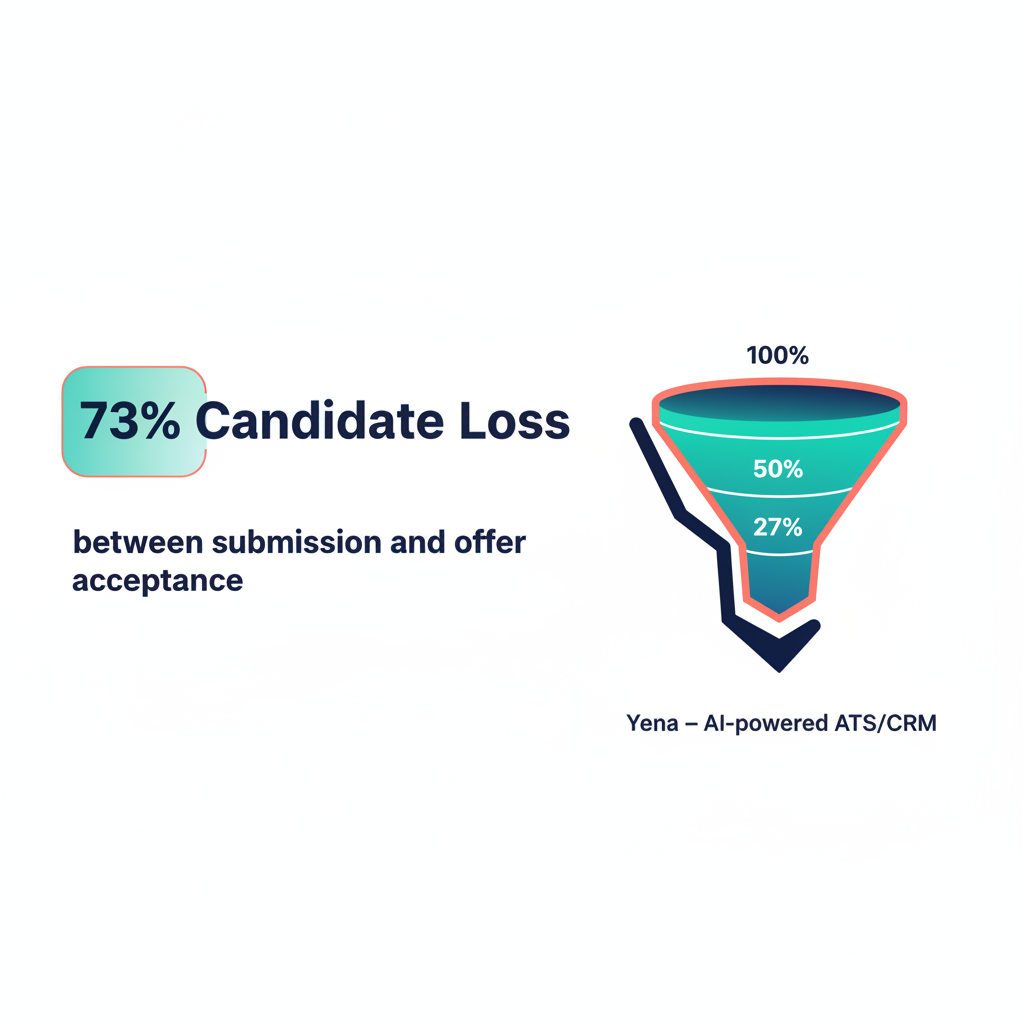
But here's the bit that hurts: Bullhorn's 2024 Global Recruitment Insights Report found that the average recruitment agency loses 73% of candidates between initial submission and offer acceptance. Not because they're unqualified — because the process is too slow, communication drops off, or competitors move faster.
Let's do the brutal calculation:
- You source 100 candidates for a role
- You submit 40 to the client (60% lost to poor matching or slow processing)
- Client interviews 12 (70% rejection rate)
- 3 reach final stage (75% drop-off)
- 1 accepts the offer (67% fall-through rate)
That's a 1% conversion rate from sourced to placed. If you're paying a researcher £35K/year to source those 100 candidates, plus another £8K in LinkedIn Recruiter licences and database subscriptions, you're spending £430 per candidate sourced and £43,000 in sunk costs for every placement.
Add the £30K fee you're actually collecting, and your gross margin per placement is... not as healthy as it should be.
Why SaaS Founders Measure Velocity (and Recruiters Don't)
When I was CEO of Peero, our product team obsessed over time-to-value — how quickly could a new user go from sign-up to their first "aha" moment? We measured it in minutes. We had Slack alerts when it crossed 8 minutes.
Why? Because velocity compounds. A SaaS funnel that converts 5% of trials to paid in 7 days will always beat one that converts 6% in 30 days. The faster one gets 4x more attempts in the same period.
Recruitment works the same way. Two agencies with identical candidate quality:
- Agency A: Average time-to-placement = 45 days
- Agency B: Average time-to-placement = 30 days
Over a year, Agency A completes 8 placements per consultant. Agency B completes 12. Same effort, 50% more revenue.
But here's what baffles me: I've met recruitment MDs who can tell me their average fee to the penny, but have no idea how long candidates spend in "2nd interview" stage. They're measuring the outcome whilst ignoring the engine.
It's like a Formula 1 team caring about the trophy but not the lap times.
The Four Leaks Killing Your Pipeline Velocity
Leak #1: The Data Entry Tax (3-7 Days Lost Per Candidate)
At my previous agency, I timed how long it took a consultant to fully process a new candidate from LinkedIn into our legacy ATS system:
- Download their CV from LinkedIn (if available) or request it via InMail — 2-10 minutes depending on responsiveness
- Manually re-type their work history into the ATS because the parser mangled the formatting — 8-12 minutes
- Add them to the relevant job pipeline — 1 minute
- Send the introductory email template (after customising it) — 3 minutes
- Log the interaction and set a follow-up reminder — 2 minutes
Total: 16-28 minutes per candidate. For a consultant managing 80 active candidates across 6 roles, that's 21-37 hours of pure administrative slog per month.
But the real damage isn't the time — it's the delay. That candidate you found on Monday doesn't get submitted to the client until Wednesday because you've got 9 others ahead of them in the data entry queue.
Meanwhile, your competitor with a modern system that auto-enriches LinkedIn profiles and parses CVs in 8 seconds? They submitted on Monday afternoon.
The fix: AI-native ATS systems that automatically extract LinkedIn data, parse CVs with 95%+ accuracy, and pre-fill candidate profiles. What took 20 minutes should take 45 seconds.
Leak #2: The Communication Black Hole (40% Candidate Drop-Off)
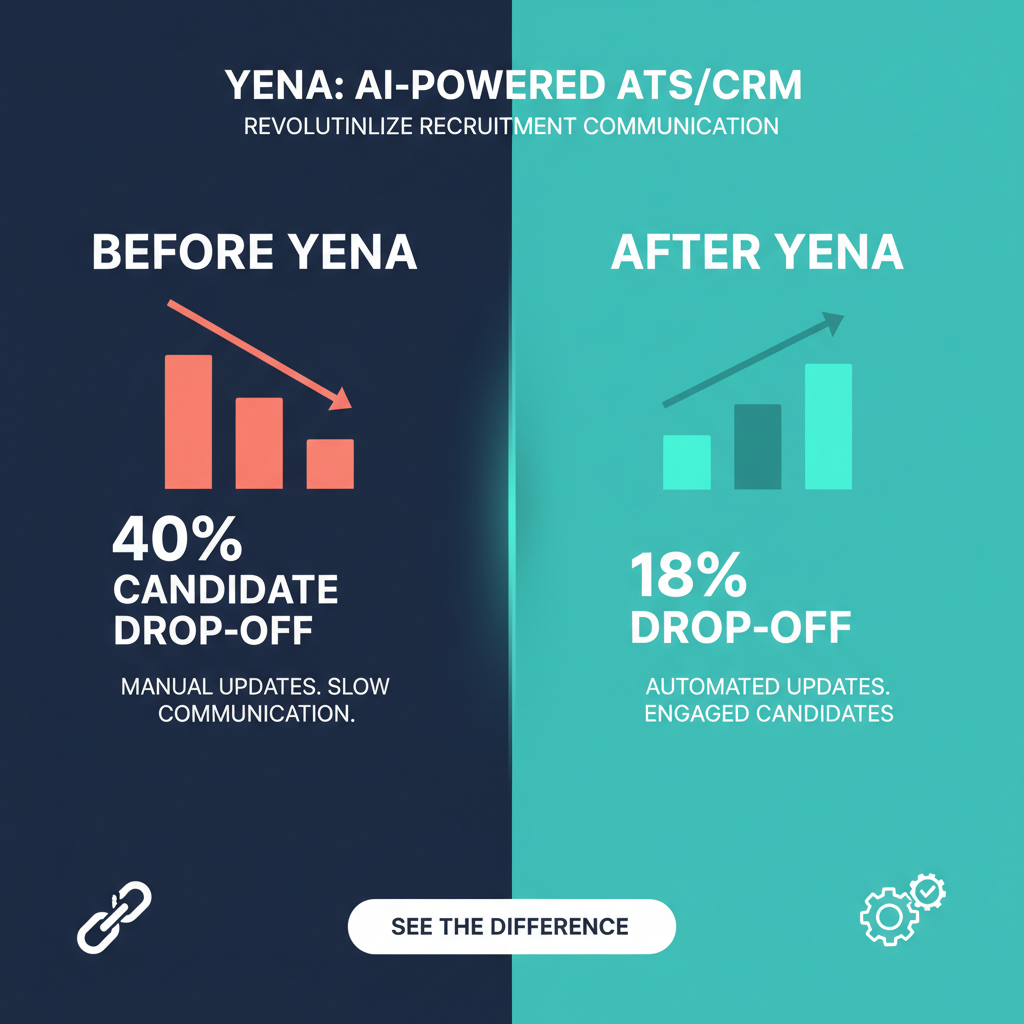
JobAdder's 2024 Candidate Experience Survey found that 40% of candidates ghost recruitment processes because of poor communication. Not because they found another job — because they assumed you'd forgotten about them.
The pattern is painfully predictable:
- Day 1: You submit candidate to client, candidate is excited
- Day 3: Candidate emails asking for an update
- Day 5: You reply "still waiting to hear back from the client"
- Day 8: Client finally responds requesting an interview
- Day 9: You email candidate... and they don't reply
- Day 11: You try calling, no answer
- Day 14: Candidate has accepted another offer
You didn't lose them because of your service. You lost them because silence feels like rejection, and they moved on.
The irony? You were busy. You had 11 other candidates to chase, 4 client meetings, and 23 unread emails. The candidate doesn't know that. They just know you went quiet.
The fix: Automated status updates. Not robotic "your application is being reviewed" nonsense — actual, contextual updates. "Your profile has been shortlisted and is with the hiring manager. I'm chasing for interview slots and will update you by Thursday 3pm."
Better ATSs can trigger these automatically based on stage changes. The candidate stays warm, you stay top-of-mind, and the 40% drop-off rate halves.
Leak #3: The Multi-Job Blind Spot (3.2x Placement Velocity, Ignored)
Here's a stat that should change how you run your desk: Candidates who are introduced to 2+ relevant roles by the same recruiter are 3.2 times more likely to accept a placement (LinkedIn Talent Solutions, 2024).
Why? Because it signals you actually understand their career, not just their CV keywords. It builds trust. And it dramatically increases your "surface area" — even if Role A doesn't work out, Role B might.
Yet most recruiters treat every candidate as single-role inventory. You find a CFO, match them to one CFO role, and if it doesn't work out, they go back into the "database" to gather dust.
Meanwhile, you've got 3 other CFO roles on your desk that are 80% matches. But your ATS doesn't surface them. Or it does, but in a buried "suggested matches" tab you never check because you're too busy manually copy-pasting from LinkedIn.
The fix: Campaign-based candidate management. When you source a strong candidate, your system should automatically flag every relevant role they match — and let you send a single, well-crafted "You might be interested in these opportunities" email.
Netflix doesn't show you one film and call it a day. They show you 12 recommendations. Your candidate pipeline should work the same way.
Leak #4: The Feedback Loop That Never Closes (25% Wasted Effort)
Client rejects a candidate. You note it down as "not a culture fit" or "lacks sector experience" and move on.
Three weeks later, you submit another candidate with the exact same profile. Client rejects them. Same reason.
You've just wasted 6 hours of sourcing, screening, and submission effort because the feedback loop never closed.
Ask any SaaS product manager how they improve conversion rates, and they'll tell you: obsessive feedback loops. Every lost deal gets a reason code. Every churn gets an exit interview. Every A/B test gets analysed.
Recruitment agencies? Half of them don't even log rejection reasons. The ones that do store it in a free-text "notes" field that nobody reads.
The fix: Structured rejection tracking with automatic learning. When a client rejects a candidate for "too corporate, needs entrepreneurial mindset," your ATS should flag that and automatically adjust future matches to prioritise candidates from scale-ups over FTSE 100.
This isn't sci-fi. Modern recruitment systems already do this. The feedback doesn't just sit in a notes field — it actively reshapes your candidate scoring for that client.
How to Measure Pipeline Velocity (The Metrics That Actually Matter)
Right, enough theory. Here's what you should be tracking, and the benchmarks that separate slow agencies from fast ones:
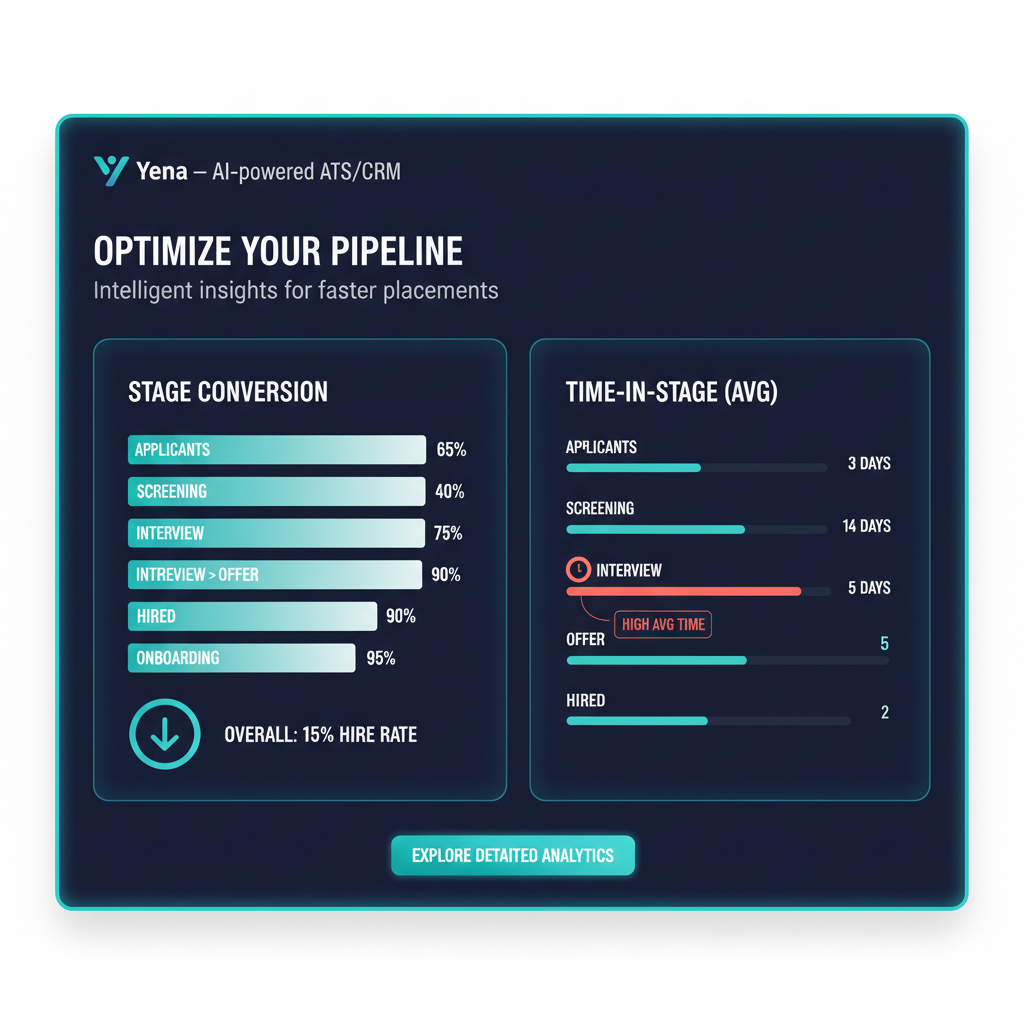
1. Stage Conversion Rates
What it is: Percentage of candidates who move from one stage to the next.
How to calculate: (Candidates moving to next stage ÷ Candidates in current stage) × 100
Benchmarks (Executive Search, UK):
- Sourced → Submitted: 35-50% (if lower, you're wasting sourcing effort on poor matches)
- Submitted → 1st Interview: 25-35% (client screening effectiveness)
- 1st Interview → Final Stage: 40-55% (quality of initial screening)
- Final Stage → Offer: 55-70% (if lower, you're overselling candidates or underselling clients)
- Offer → Acceptance: 80-92% (if lower, serious salary expectation or communication issues)
If your "Submitted → 1st Interview" rate is 15%, your candidate quality is off. If your "Offer → Acceptance" rate is 60%, you're losing deals at the finish line.
2. Average Time in Stage
What it is: How many days candidates spend in each pipeline stage.
Why it matters: Identifies bottlenecks. If candidates sit in "Client Review" for 11 days on average, your clients are slow — and you need to manage expectations or find faster-moving clients.
Benchmarks (Executive Search, UK):
- Sourced → Submitted: 2-5 days
- Submitted → 1st Interview: 5-10 days
- 1st Interview → Final Stage: 7-14 days
- Final Stage → Offer: 3-7 days
- Offer → Acceptance: 3-10 days
Total time-to-placement benchmark: 28-42 days. If you're consistently over 50 days, you're losing placements to faster competitors.
3. Candidate Response Rate (CRR)
What it is: Percentage of candidates who respond to your outreach within 48 hours.
Why it matters: Low CRR means your messaging is bland, your timing is off, or you're approaching the wrong people.
Benchmark: 35-50% for cold outreach, 60-75% for warm referrals.
If you're under 30%, your emails probably sound like this: "Hi [First Name], I came across your profile and think you'd be a great fit for an exciting opportunity with one of our clients..."
Generic. Vague. Instantly forgettable.
4. Pipeline Coverage Ratio
What it is: Number of active candidates in your pipeline divided by number of open roles.
Why it matters: Tells you if you've got enough candidate flow to hit your placement targets.
Benchmark: 8-12 active candidates per open role (executive search). Below 6? You're flying too close to the sun. Above 15? You're probably wasting sourcing effort on low-quality matches.
The 30-Day Pipeline Velocity Sprint
You don't need a £40K Bullhorn overhaul to fix this. Here's what you can do in the next 30 days:
Week 1: Audit Your Current State
Export your last 50 placements from your ATS (or build a spreadsheet if your ATS is pre-digital). Calculate:
- Average time-to-placement (sourced to offer accepted)
- Stage conversion rates (what % move from submitted → interview → offer → accepted)
- Where candidates are dropping out most
This is your baseline. No judgement, just data.
Week 2: Identify Your Biggest Leak
Look at your audit. Where's the biggest drop-off?
- If it's "Sourced → Submitted," your matching is weak
- If it's "Submitted → Interview," client expectations are misaligned
- If it's "Offer → Accepted," you're losing to counter-offers or salary gaps
Pick ONE leak to fix. Trying to fix everything at once guarantees you'll fix nothing.
Week 3: Implement One Improvement
Examples:
- If matching is weak: Add a "rejection reason" mandatory field and review patterns weekly
- If clients are slow: Implement a 48-hour "no response = follow-up" rule
- If candidates ghost you: Set up automated "still interested?" check-ins every 5 days
Week 4: Measure Again
Did your one improvement move the needle? Even a 5% conversion lift at one stage compounds across the funnel.
Repeat monthly. Velocity improvements compound.
The £1.2M Question
Here's the maths that should get your MD's attention:
Let's say you're a 6-person recruitment team. Each consultant targets 12 placements per year at an average fee of £25K. That's £1.8M in billings.
Now, what if you improved pipeline velocity by just 20%? Not doubling it — just shaving 6 days off a 30-day average time-to-hire.
- Each consultant now completes 14.4 placements instead of 12
- That's 2.4 extra placements per person
- Across 6 consultants: 14.4 additional placements
- Additional revenue: £360K
Same team size. Same effort. Just faster velocity.
Or here's the flip side: Your competitor improves their velocity by 20% and you don't. They're now submitting candidates 4 days faster than you. Interviewing them 5 days sooner. Closing offers whilst you're still scheduling second interviews.
Speed is a competitive moat. And most agencies don't even measure it.
Why Most ATSs Make This Worse (Not Better)
The tragic irony: Most recruitment agencies buy an ATS thinking it'll speed up their pipeline, and it does the opposite.
Why? Because legacy systems were built for compliance and record-keeping, not velocity. They're designed to make sure you've logged every email and stored every CV in a legally compliant way. Speed was never the brief.
So you end up with:
- 14-field forms that have to be filled in before you can add a candidate
- Clunky CV parsers that get the job history wrong 40% of the time (so you manually correct it)
- No automatic candidate-to-role matching, so you're still doing it in your head
- Email templates that feel like they were written in 2006 (because they were)
I paid £33,000 per year for a system like this at my previous agency. It didn't speed us up — it just meant we had audit logs when things went wrong.
Modern systems flip the priority: speed first, compliance automatically. They auto-parse LinkedIn profiles in 8 seconds. They suggest candidate matches without being asked. They let you move candidates between stages with a single keyboard shortcut.
If your ATS feels like molasses, it's not you — it's the software.
The One Metric That Predicts Agency Growth
I've looked at dozens of recruitment agencies over the years (advising, investing, competing with). The single strongest predictor of revenue growth isn't team size, marketing spend, or niche selection.
It's average time-to-placement.
Agencies that consistently close placements in under 30 days grow 40-60% faster than agencies averaging 50+ days. Not because they work harder — because they get more at-bats.
Think about it: If you've got a 45-day average, you can realistically juggle 8-10 live roles per consultant before things start falling through the cracks. If you've got a 30-day average, you can handle 12-15.
Velocity unlocks capacity. And capacity is revenue.
So here's my challenge: Go into your ATS right now (or your spreadsheet, or wherever you track this stuff). Pick your last 20 placements. Calculate the average number of days from "candidate sourced" to "offer accepted."
If it's over 45 days, you've got a velocity problem. If it's over 60, you've got a velocity crisis.
And if you don't even track it? That's the crisis.
Your pipeline isn't slow because you need more candidates. It's slow because you're not measuring what matters.
Start measuring. Start plugging the leaks. Start moving faster.
Because your competitor already is.
About the author: Janis Kolomenskis is the founder of Yena, an AI-native ATS built for recruitment velocity. He previously ran recruitment operations at scale and got tired of paying enterprise prices for software that made his team slower, not faster. You can follow along as we build at yena.ai.