ATS for Recruitment Agencies: Why I Paid £33K/Year and What I Learnt
Picture this: You're paying the equivalent of a junior recruiter's salary just to keep your database running. That was me for three years — £33,000 annually for an ATS for recruitment agencies that felt like it was built in 2007 and never updated. Eight seats, endless frustration, and the nagging feeling I was getting absolutely mugged.
Here's the thing about most applicant tracking system agencies use: they're built like Swiss Army knives when what you actually need is a scalpel. Every feature under the sun, forty sub-menus deep, and the one thing you do twenty times a day — matching candidates to jobs — takes six clicks and a prayer.
I'm Janis, and I've run recruitment agencies for longer than I care to admit. I've paid for the expensive systems, tolerated the "enterprise solutions" that required a manual thicker than War and Peace, and watched my team waste hours fighting software instead of placing candidates. This isn't a vendor brochure. This is what I actually learnt after spending more on ATS licenses than most people spend on a car.
The Lorry vs Sports Car Problem: Why Most ATS for Recruitment Agencies Feels Slow
Most ATS for recruitment agencies was built for corporate HR teams processing inbound applications — not for agency recruiters who source proactively, track multi-channel conversations, and need to cross-reference candidates across multiple live roles simultaneously. That architectural mismatch is why legacy systems feel slow: they were designed for a fundamentally different workflow at their core.
Legacy recruitment agency software is like driving a lorry. Powerful? Sure. Gets the job done? Eventually. Built for speed and agility? Absolutely not.
The moment I realised this was during a pitch call. Senior candidate, perfect role, tight deadline. I needed to pull up three similar placements we'd made, cross-reference their comp packages, and have an intelligent conversation about trajectory. With our old ATS for recruitment agencies, this took:
- Four separate searches across different modules
- Two browser tabs because the filters wouldn't stack properly
- Three minutes of awkward "bear with me" whilst the candidate listened to keyboard clacking
We lost that placement. Not because we weren't good enough, but because we were too bloody slow.
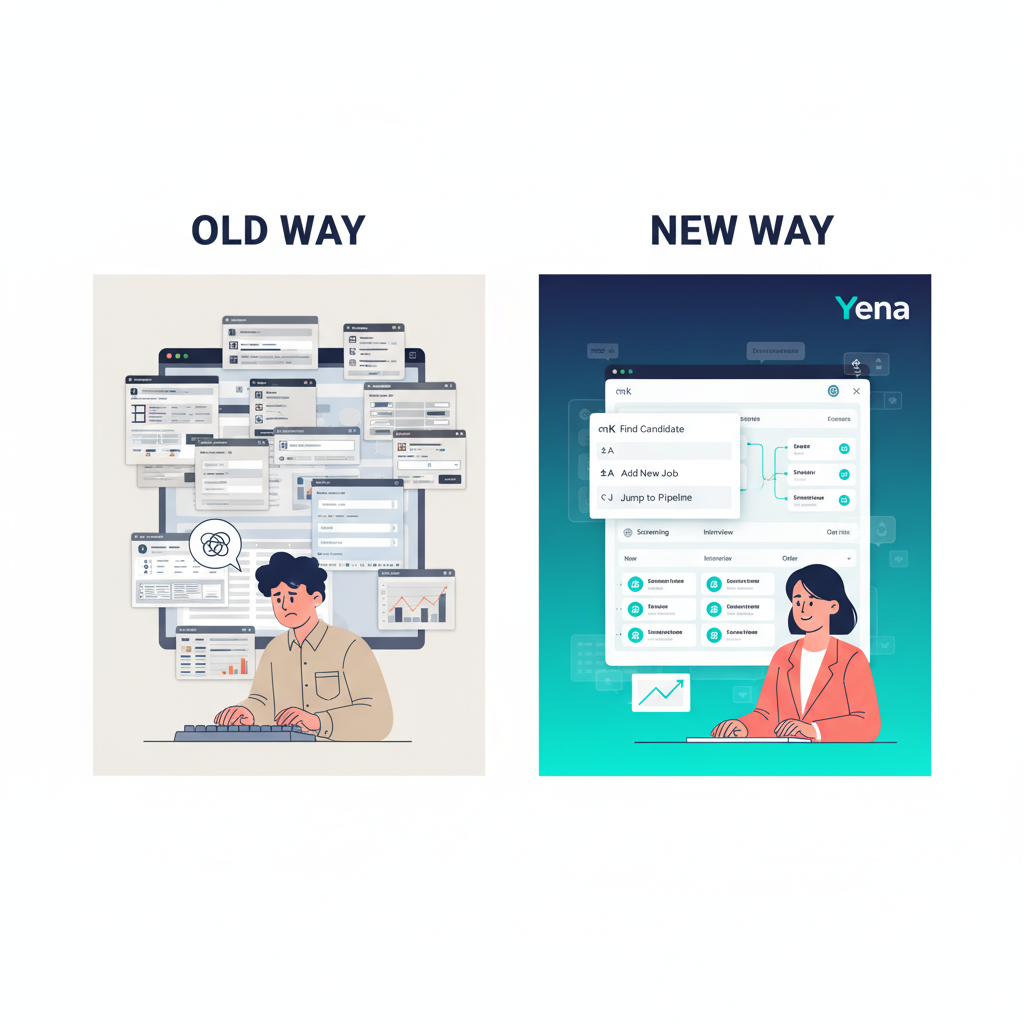
Modern agencies move at LinkedIn speed. You source a candidate at 9am, someone else contacts them at 9:15am, and by 9:30am they're in three other pipelines. The best ATS for staffing firms isn't the one with the most features — it's the one that doesn't slow you down.
What Actually Matters in an ATS for Recruitment Agencies (Hint: It's Not Job Posting)
The capabilities that genuinely matter in an ATS for recruitment agencies are AI candidate matching that understands context (not just keywords), unified multi-channel communication tracking, long-term relationship management for passive talent, and a CRM built into the core rather than bolted on. Job posting is a commodity feature; these four determine whether the software accelerates or slows down your agency.
Here's where most ATS vendors get it spectacularly wrong: they optimise for corporate HR departments, not agency recruiters.
Corporate HR posts a job, waits for applications, screens them, interviews, hires. Linear. Predictable. Boring.
Agency recruiting is chaos with a business plan attached:
- You're sourcing proactively (not waiting for inbound applications)
- One candidate might be relevant for six different roles across three clients
- You need to track who's contacted whom, when, through which channel
- Relationships matter more than single placements
- Speed beats perfection every single time
After years of this, I've distilled what recruitment agency software actually needs to do well:
1. Candidate Matching That Doesn't Require a PhD
I once worked with an ATS that had "advanced matching algorithms" — which meant boolean search strings so complex our junior recruiters needed a three-hour training session. Absolute madness.
The revelation came when I tried a system with proper AI matching. Not the marketing bollocks kind — actual semantic search that understood "CFO at a mid-market logistics company" meant different things than "CFO at a tech start-up." Different trajectories, different comp expectations, different risk profiles.
A good ATS for recruitment agencies should let you describe what you need in plain English and show you the five best matches in under ten seconds. If your team needs to learn query syntax, your vendor has failed you. For a ranked comparison of platforms that actually do this well, see our best ATS for recruiters in 2026. If CRM depth is the deciding factor, the best CRM for recruitment agencies breaks down the top options.
2. Multi-Channel Tracking (Because Nobody Emails Anymore)
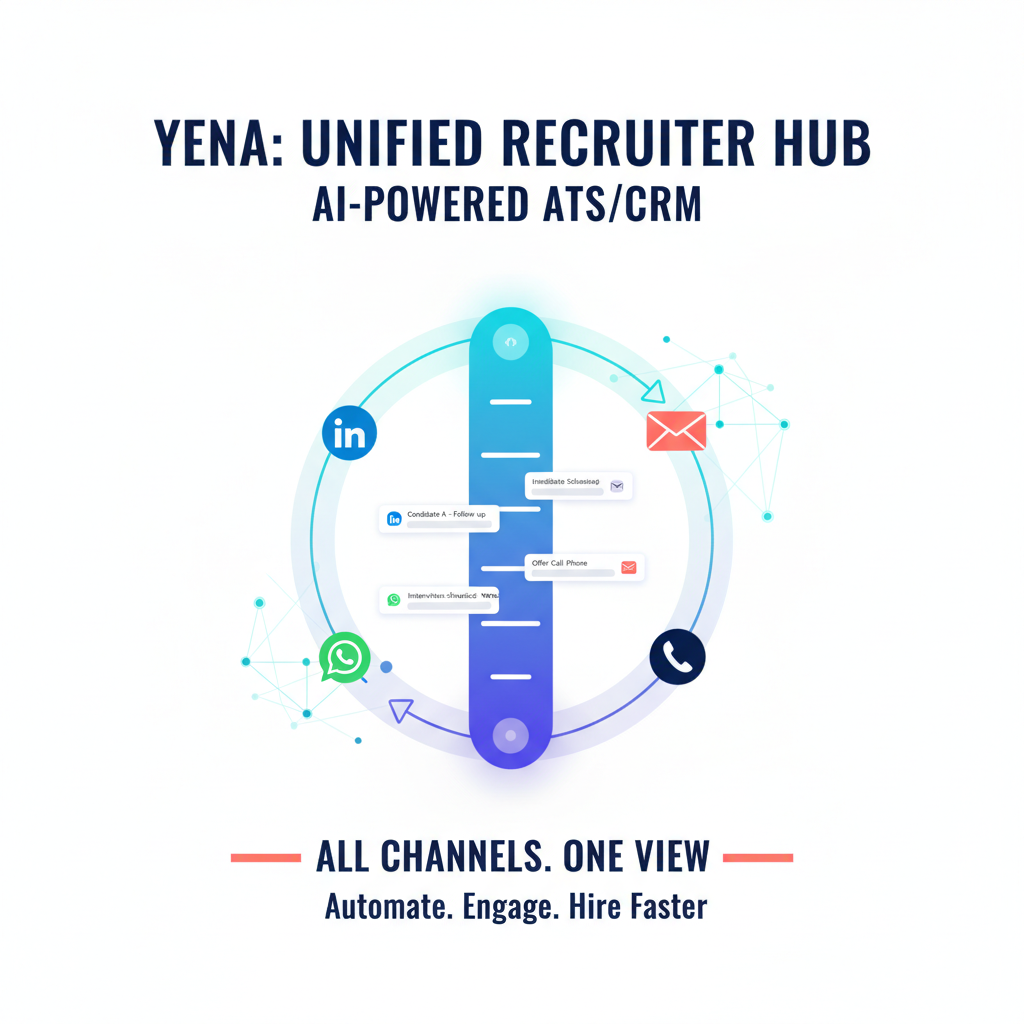
LinkedIn message. WhatsApp follow-up. Email with the job spec. Phone call to close. That's a normal Wednesday in 2026.
Our £33k system? Built when email was the only game in town. Tracking a LinkedIn conversation meant copying and pasting it into a notes field. Tracking a WhatsApp exchange meant... well, nobody did, so we just lost context constantly.
Modern applicant tracking system agencies need treats all channels as first-class citizens. When I pull up a candidate, I want to see the entire conversation history — regardless of where it happened — in one timeline. Not scattered across five different places.
3. Relationships, Not Just Transactions
Here's what separates average agencies from great ones: great agencies play the long game.
That candidate who wasn't quite right for this role? They might be perfect in six months. The hiring manager who went quiet? Their company just got acquired and now they're hiring twelve positions. The candidate who rejected your offer? They just got made redundant and they remember you treated them well.
Traditional ATS treats every interaction like a transaction. Modern recruitment agency software is actually a CRM in disguise. Campaign tracking, relationship stages, next follow-up dates, long-term pipeline management.
I've made more placements from my "keep warm" pipeline than from active job orders. But only after I had software that actually supported that workflow.
The Features Nobody Tells You About (Until You're Stuck Without Them)
The unglamorous ATS features that become dealbreakers after month three are fuzzy-matching duplicate detection (not just exact email match), bulk contact data enrichment at transparent per-credit pricing, and keyboard shortcuts or a command palette for power users. Demo scripts never show these — but they determine whether your team gains or loses hours each week.
Every ATS demo shows you the sexy features: AI matching! Chrome extension! Dashboard analytics! What they don't show you are the unglamorous things that become absolute deal-breakers after month three.
Duplicate Detection That Actually Works
We had the same candidate in our system seventeen times. Seventeen. Different spellings, different email addresses, different phone numbers. One person, seventeen records.
Why? Because our old system's duplicate detection only matched on exact email. Change jobs and get a new email? New record. Add a middle initial? New record. It was digital hoarding masquerading as an organised database.
Proper ATS for recruitment agencies uses fuzzy matching — similar names, overlapping work history, phone number patterns. It suggests merges before you create the duplicate, not after you've already got a mess.
Data Enrichment Without Breaking the Bank
Here's a dirty secret: half the contact details in your database are out of date.
People change jobs. Email addresses bounce. Phone numbers disconnect. Running a campaign on old data is like fishing in a pond that's been drained — lots of effort, zero results.
The best ATS for staffing firms integrates with data enrichment services (Apollo, ZoomInfo, whatever) and lets you refresh contact details in bulk. Not as a £5,000/month add-on, but as a core feature with reasonable pricing.
I've got a team member who enriches fifty contacts per day. That's 1,000 per month, 12,000 per year. At sensible credit pricing (say €0.10 per enrichment), that's £1,200/year. At enterprise pricing? Try £15,000. Same data, different zip code for the invoice.
Keyboard Shortcuts (The Feature Nobody Demos But Everyone Needs)
You know what the difference is between a recruiter who bills £300k/year and one who bills £180k? Speed.
Not intelligence. Not charisma. Not even network. Speed. How fast you can move candidates through your pipeline, respond to clients, send follow-ups, update records.
Our old system required clicking through menus for everything. Add a tag? Three clicks. Update a status? Four clicks. Search for a candidate? Click, click, type, click, wait.
Modern recruitment agency software has a command palette (⌘K or Ctrl+K). Type what you want, hit Enter, done. Add a tag, update a status, navigate to a record — all in under two seconds.
I timed this once. Our team saved an average of 47 minutes per day just by switching to keyboard-first software. That's four hours per week. Sixteen hours per month. Nearly a full week per quarter, per person, just from removing unnecessary clicks.
Why "Enterprise" ATS for Recruitment Agencies Usually Means "Expensive and Slow"
Enterprise ATS for recruitment agencies typically combines three compounding problems: high per-seat pricing locked into annual contracts, implementation timelines measured in months rather than days, and rigid software that requires vendor involvement for any customisation. By the time a large enterprise system is live, the agency has already paid for months of unused licences and lost the consultants who drove the selection process.
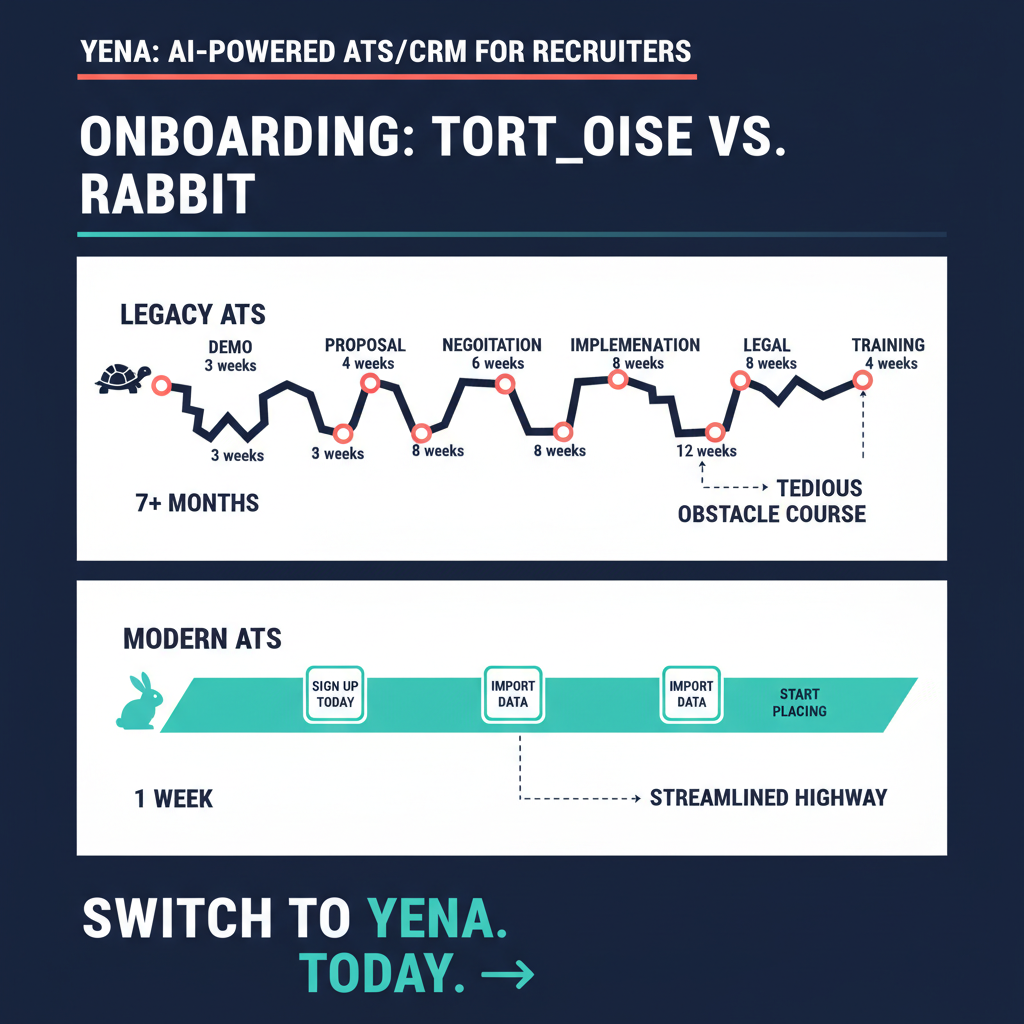
Let me tell you about enterprise sales cycles for ATS. You request a demo. Two weeks later, you get one. Three days after that, you get a proposal. The proposal requires "custom scoping" which takes another two weeks. Then you negotiate. Then you wait for legal. Then you wait for onboarding.
Four months later, you're finally live. Except you're not, because implementation takes another six weeks and training takes another month.
I once spent seven months buying an ATS. Seven months! By the time we went live, two of the team members who'd been involved in the selection process had left the company.
Here's what I've learnt: "enterprise-grade" usually means three things:
- Expensive — Because they know once you're in, switching costs are brutal
- Slow — Because the software is older than some of your recruiters
- Inflexible — Because every change requires a "roadmap discussion" and an "enhancement request"
The best applicant tracking system agencies should let you sign up today, import your data tomorrow, and start placing candidates this week. Not this quarter. Not after a six-month implementation. This week.
The Real Cost of Bad ATS for Recruitment Agencies (Spoiler: It's Not Just Money)
The true cost of a bad ATS for recruitment agencies extends far beyond the licence fee. Lost placements from slow response times, recruiter attrition from daily frustration, and the opportunity cost of wasted administrative hours can easily multiply the visible licence cost by four or five times — as the £33,000 licence that ultimately cost £155,000 annually demonstrates clearly.
When I add up what our old ATS actually cost, the license fee was the smallest part:
- License fee: £33,000/year (8 seats × £4,125/year each)
- Lost placements: At least 3 per year from slow response times (£30,000 in revenue)
- Team frustration: Two good recruiters left citing "systems that don't work" (£40,000 replacement cost)
- Wasted time: ~5 hours per week per person fighting the software (£52,000 in opportunity cost)
Total actual cost: £155,000 per year. For software that was supposed to make us more efficient.
The worst part wasn't the money. It was watching talented recruiters get bogged down in administrative nonsense. Copying data between screens. Waiting for searches to load. Rebuilding reports because the filters reset.
Good recruitment agency software fades into the background. You don't think about it. You just work. Bad software is like having a pebble in your shoe — every step reminds you it's there.
What I'd Tell My Younger Self About Buying an ATS for Recruitment Agencies
When buying an ATS for recruitment agencies, the five lessons that only become obvious after a costly mistake are: speed beats features every time, insist on a real trial with your own data rather than a vendor demo, let the recruiters who'll use it daily lead the decision, avoid minimum-commitment pricing that doesn't scale, and treat AI as a foundation requirement — not an optional add-on to evaluate later.
If I could go back and advise 2020 Janis, here's what I'd say:
1. Speed Trumps Features Every Time
Don't get seduced by feature lists. Ask: "How fast can I go from candidate search to client shortlist?" If the answer is more than 30 seconds, keep looking.
2. Try Before You Buy (Actually Try, Not Demo)
Demos are theatre. Everyone looks good in a demo. Insist on a proper trial with your actual data. Run your actual workflows. See if it's still fast on day five when you've got 10,000 candidates in the system, not the vendor's cherry-picked demo data.
3. Talk to Recruiters, Not Just Admins
Most ATS buying decisions get made by operations managers or directors who don't actually use the software daily. Wrong approach. The people who'll live in this system eight hours a day should have the loudest voice in the decision.
4. Modern Pricing Should Scale With You
If you're a three-person agency just starting out, you shouldn't be paying enterprise prices. Good ATS for recruitment agencies starts affordable and scales. Not £10k minimum commitments and annual contracts you can't escape.
5. AI Isn't a Feature, It's the Foundation
Some vendors bolt AI onto their existing system and call it innovation. Proper modern applicant tracking system agencies should have AI baked into the matching engine, the duplicate detection, the data enrichment, the candidate scoring.
If AI feels like an add-on, it was probably built that way. And add-ons break.
What the Best ATS for Staffing Firms Actually Looks Like in 2026
The best ATS for staffing firms in 2026 delivers ten specific things: contextual AI matching, unified multi-channel tracking, a LinkedIn Chrome extension for single-click import, campaign management for passive talent, keyboard-first navigation, built-in data enrichment, fuzzy-match duplicate detection, a genuine free trial, per-recruiter pricing that scales from solo to agency, and an architecture built for agencies — not repurposed corporate HR software.
I'm not going to give you a vendor comparison table. Those are all rubbish anyway — paid placements masquerading as objective reviews.
Instead, here's my checklist. If an ATS for recruitment agencies doesn't tick these boxes, I'm not interested:
- ✅ AI matching that understands context, not just keywords
- ✅ Multi-channel tracking — LinkedIn, email, WhatsApp, phone, all in one timeline
- ✅ Chrome extension that imports LinkedIn profiles without copy-paste nonsense
- ✅ Campaign management for long-term relationship building, not just active jobs
- ✅ Fast search with keyboard shortcuts — command palette, not twenty menus
- ✅ Data enrichment built in, with transparent per-credit pricing
- ✅ Duplicate detection that actually works (fuzzy matching, not exact email)
- ✅ Proper trial — at least 14 days with full features, not a locked-down demo
- ✅ Modern pricing — scales from solo recruiter to agency, no £10k minimums
- ✅ Built for agencies, not corporate HR with an "agency module" bolted on
That's it. Not fifty features. Ten things that actually matter.
The Bottom Line: Your ATS Should Accelerate You, Not Slow You Down
The right ATS for recruitment agencies disappears into the background — you think of a candidate, they appear; you spot someone on LinkedIn, one click brings them into your pipeline; you need to follow up with twenty people, it takes two minutes. If your current system makes recruiters slower than they'd be without it, you are actively paying to underperform against competitors using better tools.
I spent three years paying £33,000 annually for software that made my team slower. That's not just a bad investment — it's business malpractice.
The right ATS for recruitment agencies doesn't feel like software. It feels like a superpower. You think "find all CFOs with German SME experience" and candidates appear. You spot someone on LinkedIn, click once, and they're in your pipeline. You need to follow up with twenty candidates, and it takes two minutes, not two hours.
If your current system makes you slower, you're paying someone to sabotage your business. That's the harsh truth.
The good news? It's 2026. You don't need six-figure budgets and nine-month implementations anymore. Modern recruitment agency software is faster, smarter, and more affordable than the systems we suffered through five years ago.
The question isn't whether you need better software. It's whether you're willing to admit your current system isn't working and actually do something about it.
I waited too long. Don't make the same mistake I did.
Try an ATS Built for Speed
10-day free trial. No credit card. Import your candidates and see if we're actually faster than what you're using now. If we're not, we don't deserve your business.
Start Free Trial →