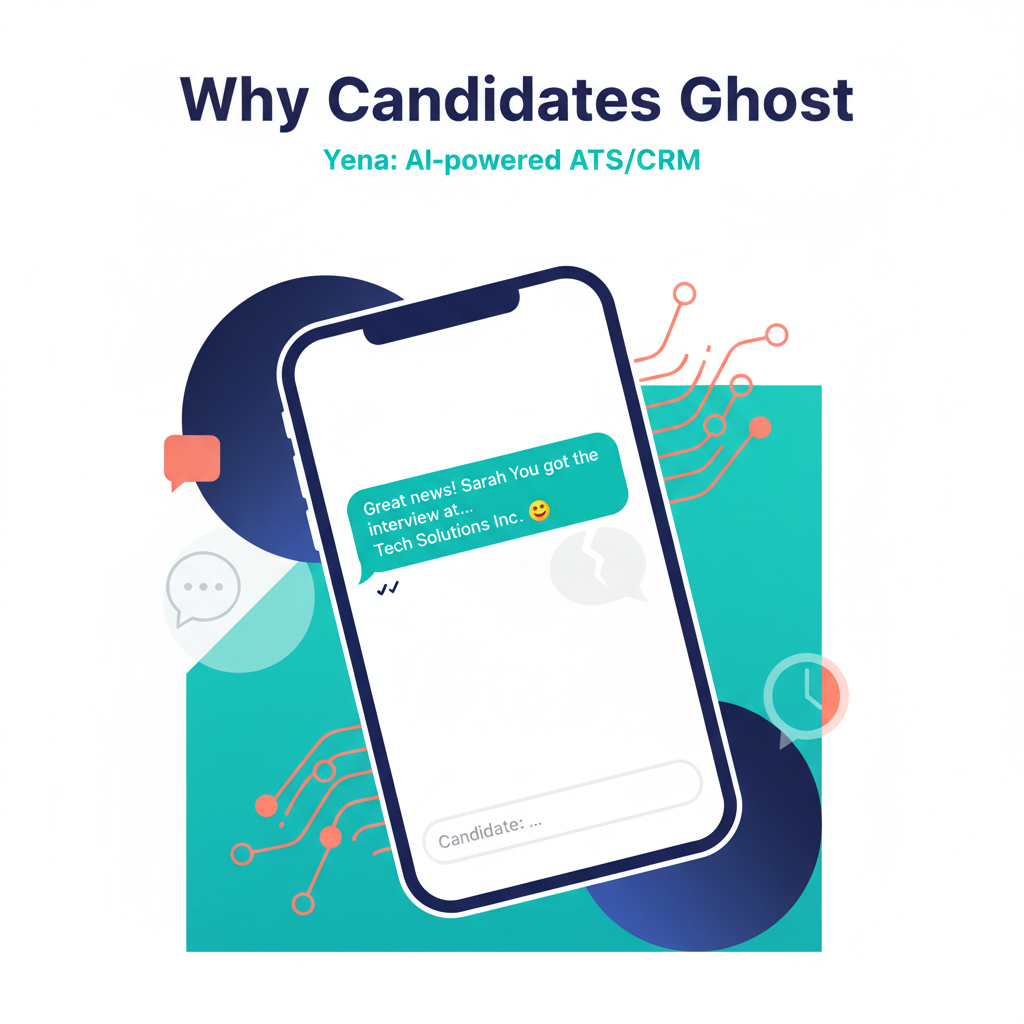
I'm going to say something controversial: your candidates aren't the problem. You are.
Last month, one of our partner agencies had 11 no-shows in a single week. Eleven. That's not bad luck — that's a broken process. And before you blame Gen Z's work ethic or "nobody wants to work anymore," let me show you what's actually happening.
Your candidates are swiping right on every vacancy they see, keeping multiple offers in play, and ghosting the moment something shinier appears. It's the Tinder Problem. And it's costing you a fortune.
The Numbers Don't Lie
Here's what the data says about candidate ghosting in 2026:
67% of candidates have ghosted an interview in the past 12 months. Not declined politely. Ghosted. That's up from 41% in 2019 and 54% in 2023. We're not talking about a small uptick — this is a seismic shift in candidate behaviour that demands process automation to keep up.
28% of accepted job offers result in no-shows on the first day. They sign the contract, you onboard their equipment, book their desk, and they simply don't turn up. No call, no email, nothing.
The average agency loses £43,000 per year to candidate ghosting when you factor in wasted interview time, client relationship damage, and restarting searches from scratch. For a 12-person agency, that's nearly one person's salary burnt on thin air.
But here's the bit that really stings: 76% of candidates who ghost one employer will ghost another within six months. You're not dealing with one-off flakes. You're dealing with systematic behaviour that's becoming the new normal.
Why Candidates Ghost (It's Not What You Think)
Everyone's got a theory. "They're lazy." "They don't respect other people's time." "The job market's too hot."
Wrong, wrong, wrong.
I've placed hundreds of candidates over the past eight years, and I've spoken to dozens who've admitted to ghosting. Here's what they actually say:
1. They're keeping their options open
Think about how you use Tinder or Hinge. You don't unmatch everyone the moment you go on one date, do you? You keep those conversations warm in case the first date's a dud. Candidates do the exact same thing with job applications.
They've got three interviews lined up this week. Two offers on the table. Another role they're waiting to hear back from that's 15% more money. And your interview? It's their backup plan. The moment one of those other offers comes through, they're gone. No courtesy email, no "thanks but I've found something else" — just silence.
Why? Because you trained them to do this. For years, candidates sent CVs into black holes. They'd interview six times for one role and get ghosted by the hiring manager. Now the tables have turned, and you don't like it.
2. Your process takes too bloody long
Here's a real example from one of our clients last year. Candidate applies on January 8th. First interview: January 22nd (14 days). Second interview: February 5th (another 14 days). "We'd like to make an offer" call: February 19th (another 14 days). Total time from application to offer: 42 days.
Guess what happened? The candidate had already accepted another role. Three weeks earlier.
The fastest-moving agencies in 2026 are interviewing candidates within 48 hours of application and making offers within five working days of the first interview. Anything longer and you're haemorrhaging candidates to competitors who move faster. This is why automated candidate workflows have become essential.
Your candidates aren't sitting around waiting for you to make up your mind. They're interviewing with five other agencies who move at twice your speed. If you're still doing three-round interview processes with two-week gaps between each stage, you're playing a game you've already lost.
3. You made them feel like a number
Let me paint a picture. Candidate applies for your role. Gets an automated email: "Thanks for your application. We'll be in touch if your profile matches our requirements." Three weeks pass. Nothing. Then suddenly: "Hi [FIRST_NAME], are you available for an interview on Tuesday at 2pm?"
That's not a candidate experience. That's an insult.
Your candidates are human beings with careers, families, and self-respect. If your first contact after three weeks of silence is a calendar invite with zero context, don't be surprised when they don't show up.
The agencies that never get ghosted? They text candidates within an hour of application. They send voice notes explaining the role and why it's a good fit. They treat candidates like mates, not application numbers. And guess what? Those candidates show up.
4. The market's too good (for them)
This one's painful, but it's true: if you're recruiting in tech, finance, or healthcare in 2026, your candidates have options. Lots of them.
A decent software engineer with five years' experience can land three interviews in a week without even updating their LinkedIn. A qualified accountant in London has recruiters in their inbox every single day. A nurse? Hospitals are offering £5,000 sign-on bonuses just to get them through the door.
Your candidates aren't ghosting because they're rude. They're ghosting because they can. The market's in their favour, and they know it.
What Doesn't Work (Stop Doing These Things)
Before I tell you what actually works, let me save you some time by listing the things agencies try that make zero difference:
Sending reminder emails the day before the interview. If a candidate's already decided not to show up, a calendar reminder isn't going to change their mind. You're not fixing the problem — you're just annoying people who were already planning to attend.
Making candidates sign "commitment agreements." I've seen agencies try this. "By signing this form, you agree to attend the interview and provide 24 hours' notice if you need to cancel." Guess what? People who ghost don't care about agreements. They're not reading your terms and conditions.
Longer screening calls to "filter out flakes." This just adds friction to your process and drives away good candidates who are time-poor. The people who ghost aren't doing it because they weren't screened properly — they're doing it because something better came along.
Guilt-tripping candidates. "Do you know how much time we've invested in you?" Yes, they do. And they still don't care. Guilt doesn't work when there are ten other agencies offering similar roles with faster processes and better communication.
What Actually Works (Do These Things Instead)
Right. Here's what we've tested at Cain & Mann and with the agencies using Yena. These are the only tactics that measurably reduce ghosting rates:
1. Speed is everything
If a candidate applies on Monday morning, they should have a response by Monday afternoon. Not next week. Not "when we've reviewed all applications." That day.
The data's clear: candidates who get contacted within 24 hours of application are 4.2 times less likely to ghost than candidates who wait three or more days for a response. Why? Because they haven't had time to apply to six other roles yet.
We built Yena to parse CVs and surface the best candidates in under 60 seconds specifically for this reason. By the time your competitors have opened their email, you've already scheduled the interview.
2. Text them, don't email them
Email is where communication goes to die. Your candidates check their phone 96 times per day. They check email maybe twice, and half of those emails go straight to spam anyway.
Send a text within an hour of application. Something like:
"Hi Sarah, Janis here from Cain & Mann. Just seen your application for the Finance Director role at [Company]. Really like your background at KPMG. Free for a quick 10-min call tomorrow at 11am to talk through it? Reply YES and I'll send a calendar invite."
Texts get 98% open rates. Emails get 22%. It's not even close.
3. Make them say yes multiple times
Here's a psychological trick that works: if you can get a candidate to say "yes" three times before the interview, they're far less likely to ghost.
First yes: "Are you still interested in this role?" (Text, same day as application)
Second yes: "Can you confirm you're free Tuesday at 2pm?" (Text, when scheduling)
Third yes: "Looking forward to meeting you tomorrow. Can you confirm you're still on?" (Text, day before interview)
Each yes is a micro-commitment. Each micro-commitment makes it psychologically harder to ghost. It's the same principle casinos use to keep you at the table — small commitments lead to bigger commitments.
4. Tell them what happens next
Candidates ghost because they feel uncertain. They don't know if this is the right role. They don't know how many more interviews there'll be. They don't know when they'll hear back.
Kill the uncertainty. After every interaction, tell them exactly what happens next:
"Thanks for applying, Sarah. Here's what happens next: I'll give you a call tomorrow at 11am to talk through the role (10 minutes). If we both think it's a fit, I'll send you the full job spec and we'll book a formal interview with the client for later this week. The whole process takes 5-7 days from first call to offer. Sound good?"
Suddenly, the candidate knows the timeline. They know the process. They know what to expect. And people don't ghost processes they understand.
5. Build scarcity (but make it real)
Candidates ghost roles they think will still be there next week. If your vacancy feels like it'll be open forever, there's no urgency to show up.
Create real scarcity:
"Just so you know, we're interviewing three other candidates this week and our client wants to make a decision by Friday. If you're serious about this role, I'd recommend moving quickly."
Notice I said real scarcity. Don't lie. Don't say "we're interviewing ten people" if you've only got two applicants. Candidates can smell bullshit, and if they catch you lying, they'll ghost you on principle.
6. Make the interview worth their time
Here's a radical idea: what if your interviews were actually valuable for candidates, even if they don't get the job?
One agency I know gives every candidate a free 15-minute "career consultation" as part of the interview. They review the candidate's CV, suggest improvements, and offer advice on how to position themselves for their next role. Even if the candidate doesn't get hired, they leave with something useful.
Guess how many of their candidates ghost? Less than 5%. Because even if the role isn't right, the interview is still worth attending.
7. Use AI to spot flight risks early
This is where modern ATS platforms earn their money. Yena's career intelligence engine flags candidates who are statistically more likely to ghost based on their work history:
- Job hopping patterns (three roles in two years = higher flight risk)
- Gaps between roles (suggests they're interviewing multiple places simultaneously)
- Rapid career progression (they're ambitious and probably fielding multiple offers)
- LinkedIn activity spikes (lots of connection requests and profile views = active job hunting)
If your platform flags a candidate as high flight risk, you change your approach. Faster communication. More personal touch. Tighter timeline. You don't treat them the same as a passive candidate who's only applied to your role.
The Tinder Problem Isn't Going Away
Here's the uncomfortable truth: candidate ghosting is the new normal. It's not a Gen Z thing or a post-pandemic thing or a hot market thing. It's a structural shift in how candidates approach job searching, and it's here to stay.
Your candidates have more power than ever before. They can apply to 20 roles in an hour, schedule five interviews in a week, and compare offers like they're shopping on Amazon. The agencies that thrive in this environment aren't the ones complaining about "kids these days" — they're the ones who've adapted their processes to match how candidates actually behave in 2026.
Speed wins. Personal touch wins. Transparency wins. Everything else is just noise.
And if you're still sending bulk emails, taking two weeks to schedule interviews, and wondering why candidates keep ghosting? You're not unlucky. You're just slow.
What We Built to Fix This
Full disclosure: this problem drove me mad enough that we built Yena specifically to solve it.
Our platform parses CVs in under 60 seconds, so you can respond to applications the same day they arrive. It flags flight risk candidates so you know who needs a faster, more personal touch. It integrates with WhatsApp and SMS so you can text candidates directly from the platform. And it tracks every touchpoint through integrated candidate tracking, so you know exactly when you last contacted someone and what you said.
Does it eliminate ghosting completely? No. Because unless you're offering 50% more salary than every competitor, some candidates will always keep their options open. But our agencies report ghosting rates below 15%, compared to the industry average of 67%.
That's not magic. That's just treating candidates like humans, moving at their speed, and building a process that respects their time as much as yours.
If you're tired of no-shows, phantom acceptances, and the Tinder Problem wrecking your placement rates, you can try Yena free for 10 days. No credit card, no sales call, just access to the full platform so you can see if it works for your agency.
Or keep doing what you're doing and hope your candidates start caring about your time as much as you wish they did.
Your call.