Remember when "AI in recruitment" meant keyword matching and automated email replies? That was eighteen months ago. In 2026, we're watching something entirely different unfold: autonomous AI agents that work like junior recruiters — except they never sleep, never complain, and process 200 CVs whilst you're making coffee.
According to Korn Ferry's recent Talent Acquisition Trends report, more than half of talent leaders are planning to add autonomous AI agents to their teams this year. Not chatbots. Not RPA scripts. Actual digital teammates that make decisions, prioritise candidates, research companies, and update your applicant tracking system without being told.
If that sounds like science fiction, you're about three funding rounds behind reality.
What Are Autonomous AI Agents? (And Why They're Not Just Fancy Chatbots)
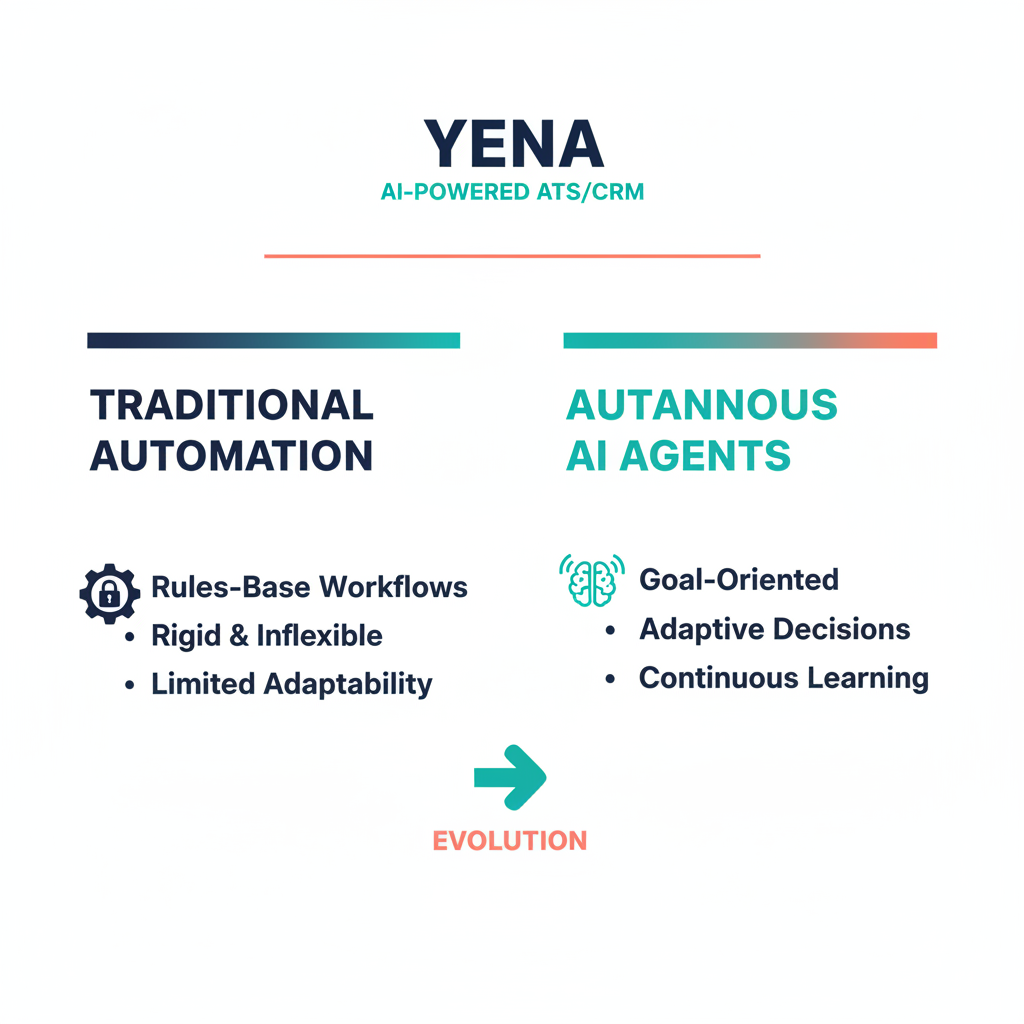
Here's the distinction that matters: traditional recruitment automation follows rules. If candidate has "Python" on CV, then shortlist. Autonomous AI agents follow goals.
Tell a traditional automation tool to "find senior Python developers in Berlin" and you'll get a boolean search. Tell an autonomous agent the same thing and it'll:
- Search LinkedIn, GitHub, Stack Overflow, and tech community forums
- Cross-reference employment histories to identify people who've recently changed roles (higher response rates)
- Check company funding news to spot engineers at startups that just missed Series B (often open to new opportunities)
- Draft personalised outreach messages referencing their actual work (not just job titles)
- Schedule follow-ups based on engagement patterns
- Update your CRM with enriched profiles including tech stack preferences, salary expectations (inferred from Glassdoor patterns), and likely response times
All of this happens without you clicking a single button. That's the difference.
The Junior Recruiter Metaphor (That Actually Makes Sense)
Think about your best junior recruiter. Not the one who blindly follows scripts, but the sharp one who gets it after you explain a role once. You say "Find me a CFO for a €50M Mittelstand manufacturing firm, someone who's done M&A and speaks fluent German," and they come back three days later with eight solid profiles, complete with notes on why each person might be interested.
That's what autonomous AI agents do — except they come back in three hours, not three days.
They handle the research grind: parsing CVs, enriching LinkedIn profiles, validating email addresses, checking if candidates have changed jobs recently (a leading indicator of openness), identifying transferable skills that traditional keyword matching misses, and building a shortlist ranked by genuine fit rather than arbitrary keyword density scores.
I spent £33,000 a year on legacy ATS platforms at my previous company. Know what I got for that? A glorified database that made my team slower. Now I'm running an AI-native recruitment platform, and the biggest shift isn't the technology — it's realising that AI agents don't replace recruiters; they multiply them.
What Autonomous AI Agents Actually Do in Recruitment (Real Examples)
Let's get concrete. Here are five tasks that autonomous agents are handling right now in 2026:
1. Candidate Sourcing on Autopilot
You give the agent a job description. It identifies the must-have skills (not just keywords — actual capabilities), finds people with those skills across multiple platforms, checks their career trajectory to spot rising stars vs. plateaued performers, and shortlists candidates who are statistically likely to respond based on their activity patterns.
One recruitment agency I spoke with recently set their agent loose on a "Senior DevOps Engineer, Munich, startup experience" brief. The agent returned 43 candidates in six hours. The recruiter manually reviewed them, sent 12 InMails, and placed one candidate within three weeks. Total human time invested: four hours. That's an 85% reduction in sourcing time.
2. CV Screening With Context (Not Just Keywords)
Traditional ATS platforms look for exact keyword matches. Autonomous agents understand equivalence. If your job spec says "Salesforce experience required," a good agent knows that someone who's implemented HubSpot, Pipedrive, and custom CRM integrations probably has the transferable skills you need.
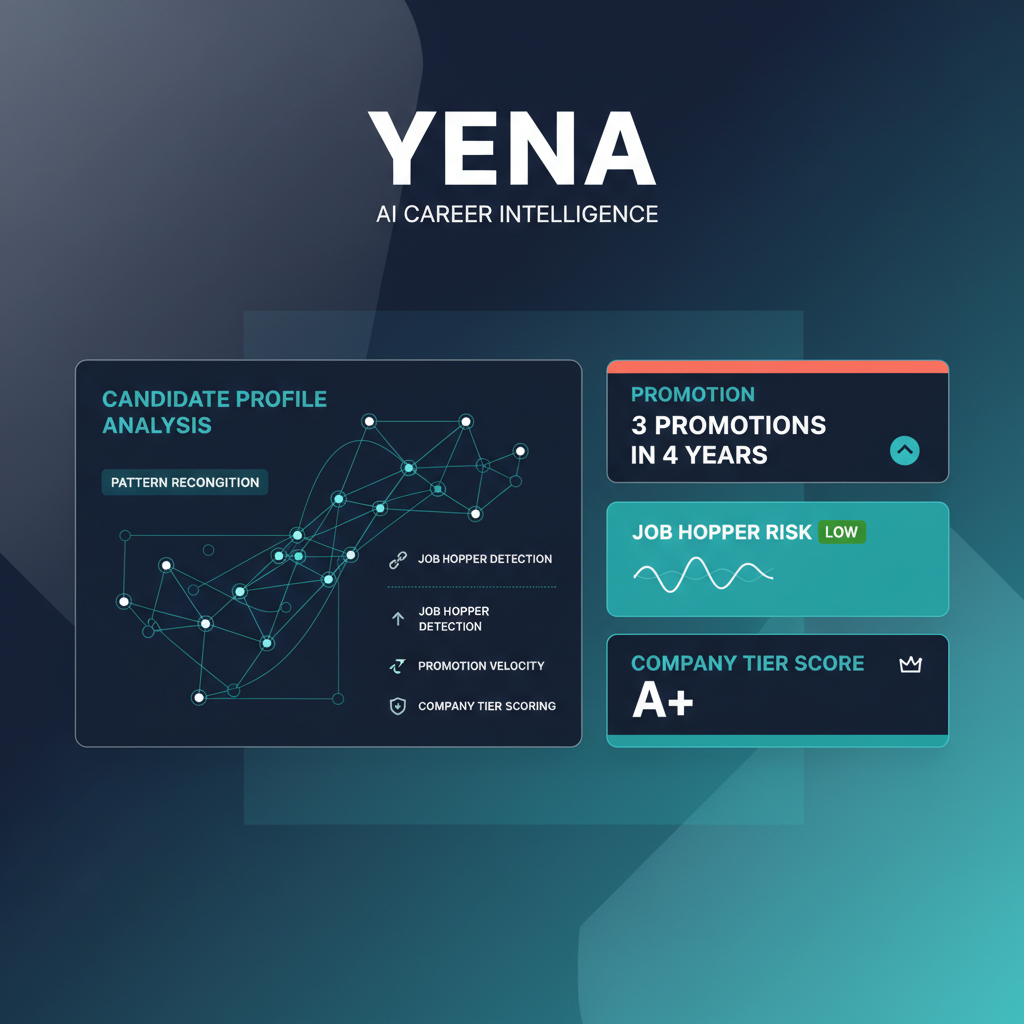
They spot patterns like: "This candidate moved from a 20-person startup to a 500-person scale-up — they've seen hypergrowth." Or: "Three promotions in four years at the same company — high performer, likely loyal." Or: "Two six-month stints in a row — possible job hopper, needs deeper vetting."
This is career intelligence, not keyword bingo.
3. Outreach Personalisation at Scale
Here's where it gets interesting. A decent AI agent can draft personalised outreach messages that reference a candidate's actual work. Not "I saw your profile and think you'd be a great fit" generic nonsense. Real specificity: "I noticed you led the migration from monolith to microservices at [Company X] — we've got a client tackling the exact same challenge at 10x scale."
One agency tested this with 200 candidates. The AI-drafted messages (reviewed and sent by humans) had a 34% response rate. Their previous templated outreach? 11%. That's a 3x improvement just from adding context.
4. Interview Scheduling Without the Email Tennis
Everyone hates scheduling interviews. It's three days of "Does Tuesday at 2pm work?" back-and-forth whilst your hiring manager gets increasingly irritated.
Autonomous agents integrate with calendars, propose times based on everyone's availability, handle rescheduling when someone's train is delayed, and send reminders. One less thing for your team to think about.
5. Pipeline Hygiene (The Unglamorous Bit That Matters)
Your candidate database is probably a mess. Duplicate profiles, outdated contact details, candidates stuck in "Interview Scheduled" status from four months ago when they ghosted you.
AI agents handle the cleanup: merging duplicates, flagging stale records, enriching profiles with updated LinkedIn data, and moving candidates through pipeline stages based on activity triggers. It's boring work, but it's the difference between a CRM you trust and a data swamp you avoid.
What AI Agents Can't Do (Yet)
Let's be honest: autonomous agents aren't magic. There are clear limitations, and pretending otherwise does everyone a disservice.
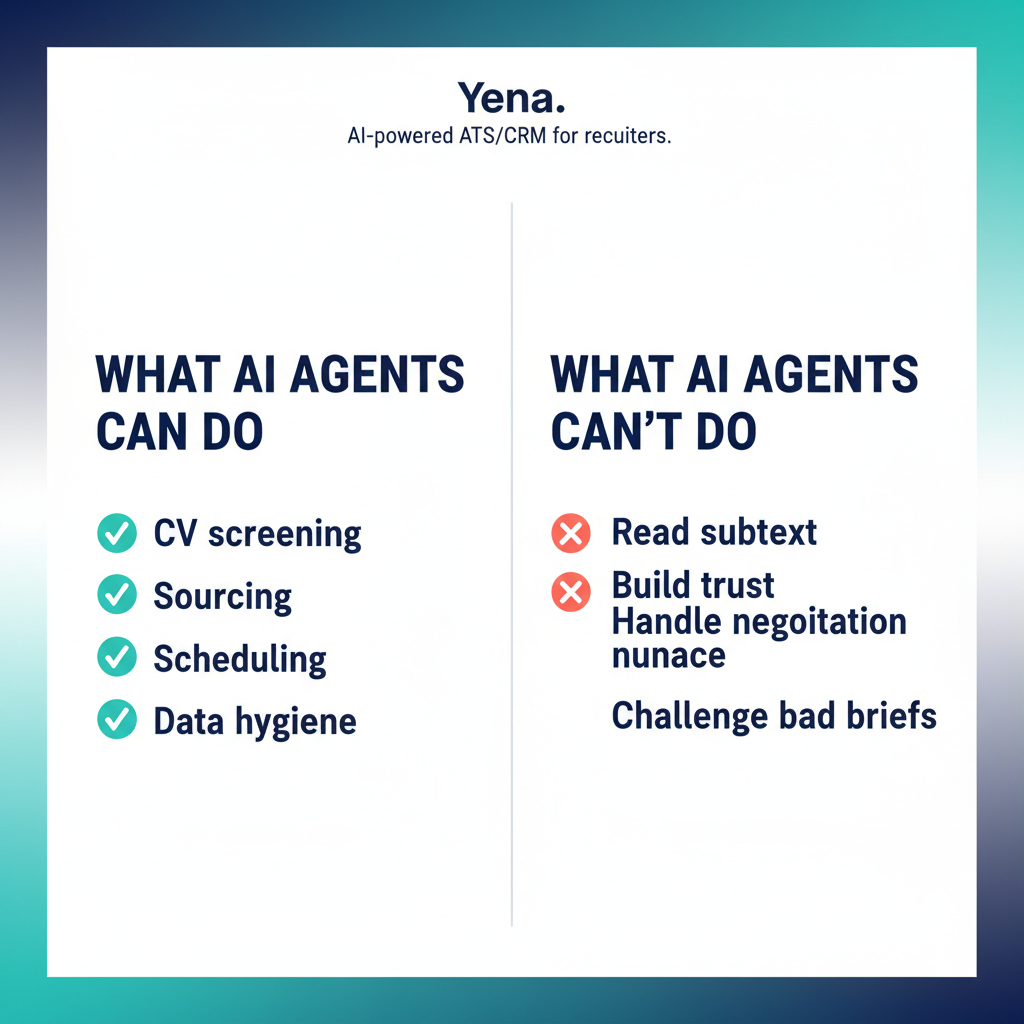
They can't read subtext. A candidate says "I'm happy in my current role but always open to opportunities." A human recruiter knows that means "I'm not moving unless you're offering 20% more and a better title." An AI agent might take them at face value and waste your time.
They can't handle negotiation nuance. When a candidate pushes back on salary, and you need to finesse the conversation around equity, bonus structure, remote working flexibility, and career progression, that's still human territory.
They can't build trust. Relationships close deals. If a candidate is choosing between two offers and your personal rapport tips the balance, that's irreplaceable human value.
They can't challenge bad briefs. A hiring manager says "Find me a senior developer for £40K." A good recruiter pushes back: "That's 30% below market — we'll struggle to find anyone decent at that rate." An AI agent just executes the search and returns thin results.
The smartest agencies in 2026 aren't replacing recruiters with AI. They're pairing them up.
How to Actually Use AI Agents Without Breaking Everything
Right, so you're sold on the concept. How do you implement this without turning your recruitment process into a chaotic experiment?
Start With One Repeatable Task
Don't try to automate your entire workflow on day one. Pick one high-volume, low-risk task. For most agencies, that's CV screening. Let the agent handle first-pass filtering, then have a human do final review before candidates move to interview stage.
Track the results. How many candidates does the agent shortlist? What percentage make it through your manual review? Are you seeing fewer false negatives (good candidates being filtered out)? After two weeks, you'll have data to decide whether to expand or adjust.
Set Clear Boundaries
Autonomous agents work best with guard rails. Define what decisions they can make independently (e.g., "shortlist candidates with 5+ years Python experience and no employment gaps longer than 6 months") versus what requires human approval (e.g., "candidates with non-traditional backgrounds who don't meet criteria but show strong potential").
This isn't about limiting the AI — it's about aligning it with your agency's risk tolerance and quality standards.
Treat Them Like Junior Recruiters (Because That's What They Are)
You wouldn't hire a junior recruiter and leave them unsupervised for three months. Same principle applies here. Review the agent's work regularly, give feedback (most modern AI systems learn from corrections), and iterate on the prompts and criteria you're feeding it.
One agency told me they spend 20 minutes every Friday reviewing their agent's performance: which candidates were shortlisted correctly, which were missed, and why. That weekly calibration keeps the system sharp.
Keep Humans in the Loop for Candidate Communication
AI agents can draft outreach messages. They shouldn't send them without human review. Not yet, anyway.
Why? Because tone matters, context matters, and occasionally the AI will confidently suggest something that's subtly wrong ("I saw you worked at Theranos for five years — impressive track record!"). Human review catches these before they damage your brand.
The EU AI Act Reality Check (Because Compliance Still Matters)
Quick reminder: if you're operating in Europe, the EU AI Act classifies recruitment AI as high-risk. Full compliance kicks in August 2026.
What does this mean for autonomous agents?
- Transparency: Candidates must be informed when AI is involved in screening or shortlisting decisions.
- Human oversight: High-stakes decisions (e.g., final rejection) require human review.
- Bias monitoring: You need to track whether your AI is inadvertently discriminating based on protected characteristics.
- Right to explanation: If a candidate asks why they were rejected, you need to be able to explain the AI's decision logic in plain English.
This isn't onerous if your ATS platform is built with compliance in mind from day one. It is a nightmare if you're bolting AI onto legacy systems that were designed in 2015.
What This Means for Small and Mid-Sized Agencies
Here's the uncomfortable truth: the agencies that adopt autonomous AI agents first will have a massive competitive advantage.
They'll shortlist candidates faster. They'll respond to enquiries quicker. They'll handle more roles with fewer recruiters. And they'll price more aggressively because their cost base is lower.
If you're a five-person boutique firm, this might sound intimidating. "How can I compete with agencies that have AI teams?" But here's the thing: you don't need an AI team. You need an AI-native platform that embeds agents into the workflow.
The barrier to entry isn't technical expertise anymore. It's willingness to change how you work.
I've watched small agencies 10x their candidate pipeline without hiring additional recruiters. The difference? They let AI agents handle the grunt work — parsing CVs, enriching profiles, scheduling interviews — whilst humans focus on relationship-building and deal-closing.
That's the automation strategy that actually scales.
The 2026 Recruitment Stack: Humans + Agents + Smart Tools
So what does the modern recruitment stack look like in 2026?
At the centre, you've got an AI-native ATS that doesn't just store data — it interprets it. Candidate profiles aren't static records; they're living intelligence files that get enriched automatically as new information becomes available.
Plugged into that core system, you've got autonomous agents handling:
- Sourcing agents — finding candidates across platforms based on your criteria
- Screening agents — parsing CVs, spotting career patterns, flagging potential issues
- Outreach agents — drafting personalised messages (with human approval)
- Coordination agents — scheduling interviews, sending reminders, updating status
- Data hygiene agents — merging duplicates, enriching profiles, archiving stale records
And then you've got humans doing what they're uniquely good at: building relationships, reading between the lines, challenging bad briefs, negotiating offers, and ultimately making the judgment calls that close placements.
It's not "humans vs. machines." It's humans with machines. The best recruitment teams in 2026 have figured that out.
The Honest Cost-Benefit Analysis
Let's talk money, because that's what agency owners care about.
A junior recruiter costs you £25K-£35K per year (plus training, plus management overhead, plus the risk they'll leave after six months). An autonomous AI agent built into your ATS? Typically £50-£150 per month as part of your platform subscription.
Yes, the agent can't do everything a human can. But it handles 60-70% of the grunt work that eats up your recruiters' time. That means your human team can focus on higher-value activities: relationship-building, consultative selling, complex negotiations.
One agency I know reduced their time-to-shortlist from 4 days to 8 hours by letting an AI agent handle first-pass CV screening. That's a 6x speed improvement. Even if the agent only has 80% accuracy (and modern agents are hitting 85-90%), the time savings make it worthwhile.
The ROI isn't "replace humans with robots." It's "enable humans to do more high-value work."
What to Look for When Evaluating AI-Native Platforms
Not all "AI-powered recruitment tools" are created equal. Here's what actually matters when you're evaluating platforms in 2026:
Native integration, not bolt-ons. If the AI feels like an afterthought feature that was added to a legacy platform, it probably is. Look for systems where AI is baked into every workflow from day one.
Explainability. When the agent shortlists a candidate or flags a red flag, can it explain why in plain English? This matters for EU AI Act compliance and for building trust with your team.
Learning capability. Does the agent improve over time as you give it feedback? Or is it running the same logic for eternity? The best systems learn from your corrections and preferences.
Human-in-the-loop design. AI should augment human decision-making, not replace it. Look for platforms that make it easy to review agent recommendations, override decisions, and provide feedback.
Data security. Your candidate database is sensitive. Make sure the platform you're using handles data with proper encryption, access controls, and GDPR compliance. Ask specific questions about where data is stored and who has access.
If a vendor can't answer these questions clearly, walk away.
The Bottom Line: Adapt Now or Play Catch-Up Later
Autonomous AI agents in recruitment aren't coming. They're here.
Over 50% of talent leaders are adding them to their teams in 2026 according to Korn Ferry. That's not a fringe experiment — that's mainstream adoption. Which means if you're not at least testing this technology, you're falling behind competitors who are.
The good news? You don't need a data science team or a six-figure budget to get started. You need an AI-native platform that embeds autonomous agents into your existing workflow, a willingness to experiment, and a clear-eyed view of what AI can (and can't) do.
Think of it this way: autonomous AI agents are like hiring a junior recruiter who works 24/7, never takes holiday, and costs less than your monthly coffee budget. They won't replace your best people. But they'll make them significantly more productive.
And in a market where time-to-fill is climbing, candidate expectations are rising, and margins are tightening, that productivity gain might be the difference between thriving and merely surviving.
The agencies that figure this out first will dominate their markets. The ones that wait will spend 2027 wondering why they're losing placements to competitors who seem to move twice as fast.
Which camp do you want to be in?