I've spent three hours on LinkedIn this morning. Found twelve candidates who might be interested in a CFO role for a mid-market logistics firm. Copied their profiles into a spreadsheet. Drafted personalised messages. Sent connection requests.
Tomorrow, I'll check who accepted. The day after, I'll follow up with the ones who did. Maybe 20% will reply. Maybe 5% will actually be interested.
That's the old way. That's what candidate sourcing tools 2026 are meant to kill.
Here's the uncomfortable truth: if you're still treating sourcing like a manual hunt — searching Boolean strings, copy-pasting profiles, tracking outreach in spreadsheets — you're competing with one hand tied behind your back. The best sourcing tools for recruiters have evolved from dumb databases into intelligent systems that understand context, predict fit, and automate the boring bits.
This isn't about replacing recruiters. It's about replacing the tedious nonsense that stops you from actually recruiting.
"Recruiters who adopt AI sourcing tools report spending 40% less time on initial candidate identification — freeing that time for relationship-building and client management." — LinkedIn Talent Solutions, 2025 Global Talent Trends
The Fishing Net vs. Spear Hunting Problem
Traditional candidate sourcing works like spear fishing: each manual search targets one candidate at a time, requiring constant individual effort that doesn't scale. Modern AI sourcing tools function more like smart fishing nets — you define parameters once, the system scans at scale, and AI filters what returns by predicted fit and engagement likelihood, freeing recruiters for conversations rather than searches.
Think of traditional sourcing like spear fishing. You spot a candidate, aim carefully, throw your spear (a carefully crafted InMail), and hope you hit. Miss? Start over. Hit but they're not interested? Start over. It's exhausting, slow, and wasteful.
Modern AI sourcing tools are more like smart fishing nets. You set parameters (seniority, industry, location, skills), the net goes out automatically, and the AI sorts what comes back — keeping the relevant profiles, discarding the noise, even predicting who's most likely to respond.
The metaphor holds: spear fishing requires constant manual effort. Nets scale. And the best nets in 2026? They're intelligent. They learn what you're looking for, adapt to patterns, and save you from drowning in irrelevant profiles.
What Actually Changed in Candidate Sourcing Tools 2026
Four advances separate 2026 candidate sourcing tools from earlier generations: context-aware AI matching that evaluates career trajectories rather than keywords, multi-channel orchestration across LinkedIn, GitHub, and Apollo simultaneously, predictive engagement scoring to identify who is actually moveable right now, and campaign-based outreach automation that tracks full sequences rather than individual one-off messages.
Let's get specific. Here's what separates legacy tools from best candidate sourcing software in 2026:
1. Context-Aware AI Matching (Not Just Keyword Spam)
Old-school sourcing tools matched keywords. "Python" in the job description? Show me every profile with "Python" mentioned. Doesn't matter if they used it once in 2019 for a weekend project.
Modern tools understand context. They analyse career trajectory, company prestige, role progression, and skills depth. A senior engineer at Google who's been promoted twice in four years scores differently than someone who's bounced between five startups in the same timeframe.
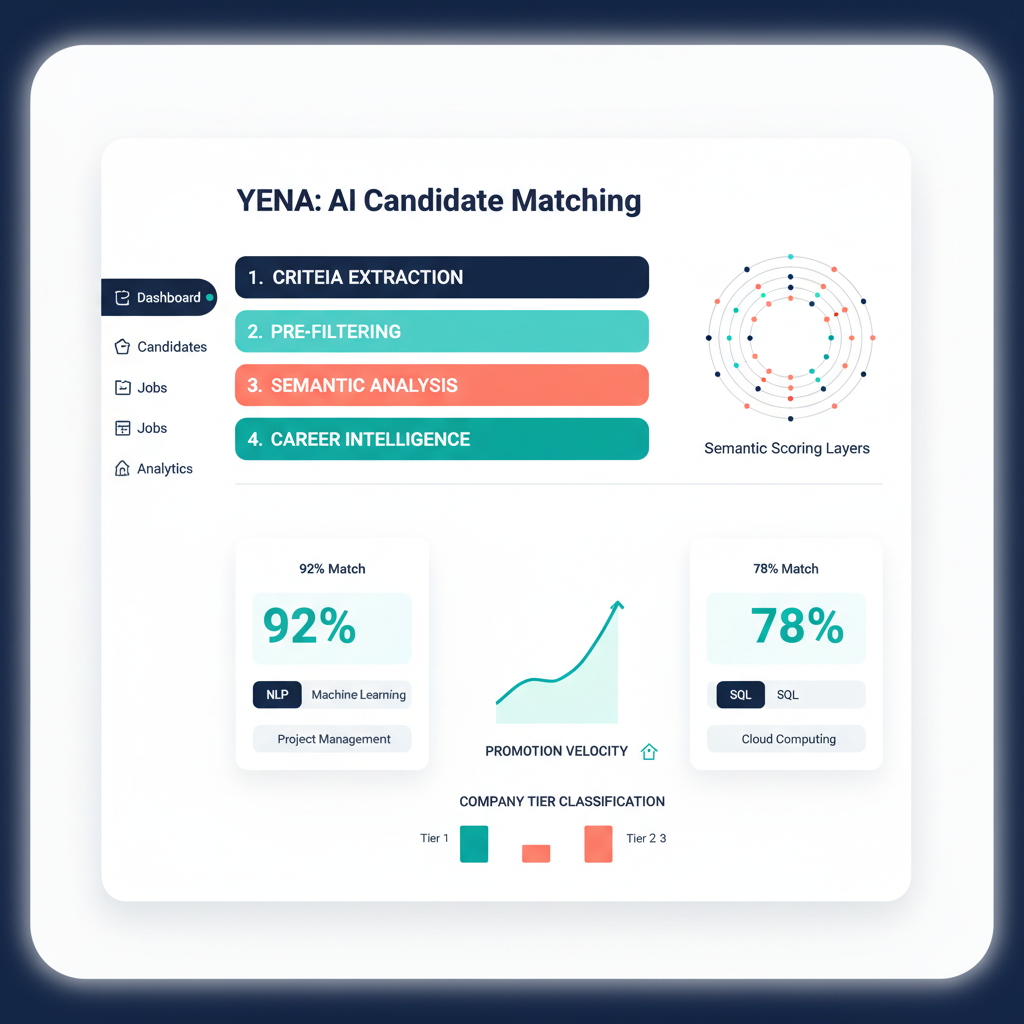
When I use Yena's AI matching engine, it doesn't just match keywords — it evaluates five layers: criteria extraction, pre-filtering, semantic scoring, career intelligence (promotion velocity, job hopper detection, company tier), and deep LLM evaluation for top candidates. That's not sourcing. That's talent intelligence.
2. Multi-Channel Orchestration (LinkedIn Isn't Enough Anymore)
LinkedIn is still the primary hunting ground, but relying solely on LinkedIn is like fishing in a pond when there's an ocean next door. The best sourcing tools for recruiters in 2026 pull from multiple sources:
- GitHub for developers (real code beats LinkedIn endorsements)
- Apollo.io for verified emails and decision maker searches
- Company websites (career pages reveal who's hiring — and therefore who might leave)
- Industry forums and Slack communities (where the best talent actually hangs out)
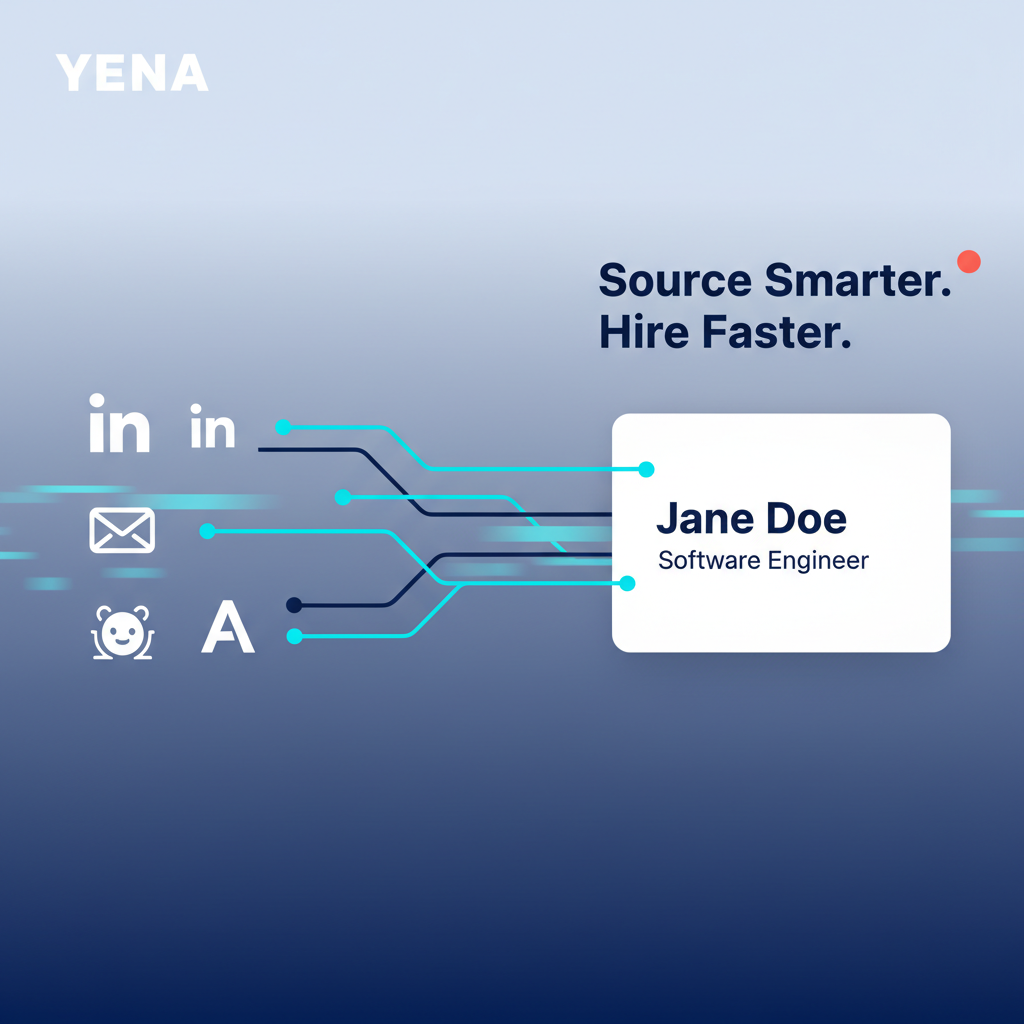
You can't do this manually. Not at scale. That's why tools that integrate enrichment (like AI-powered recruitment platforms) matter — they pull data from everywhere, unify it, and give you one complete profile instead of fragmented breadcrumbs.
3. Predictive Engagement Scoring (Who's Actually Moveable)
Here's a question most candidate sourcing tools 2026 still can't answer: is this candidate even open to new roles?
Some tools now analyse signals:
- Recent LinkedIn activity (profile updates, new connections, content sharing)
- Company news (layoffs, acquisitions, leadership changes)
- Tenure patterns (someone who's been in a role for 18 months is statistically more moveable than someone who started 6 months ago)
It's not perfect. But it's better than spraying messages at 100 people and hoping 3 reply. Engagement scoring helps you prioritise — who to approach first, who to nurture, who to skip entirely.
According to SHRM's Talent Acquisition Benchmarking research, recruiters who use data-driven prioritisation fill roles 28% faster on average than those relying on intuition alone. Engagement scoring isn't a gimmick. It's just operationalising what good recruiters already do instinctively — but at scale.
4. Campaign-Based Outreach (Not One-Off Messages)
Most recruiters still treat outreach as individual transactions. Find candidate → send message → wait. Find another candidate → send another message → wait. Repeat 50 times.
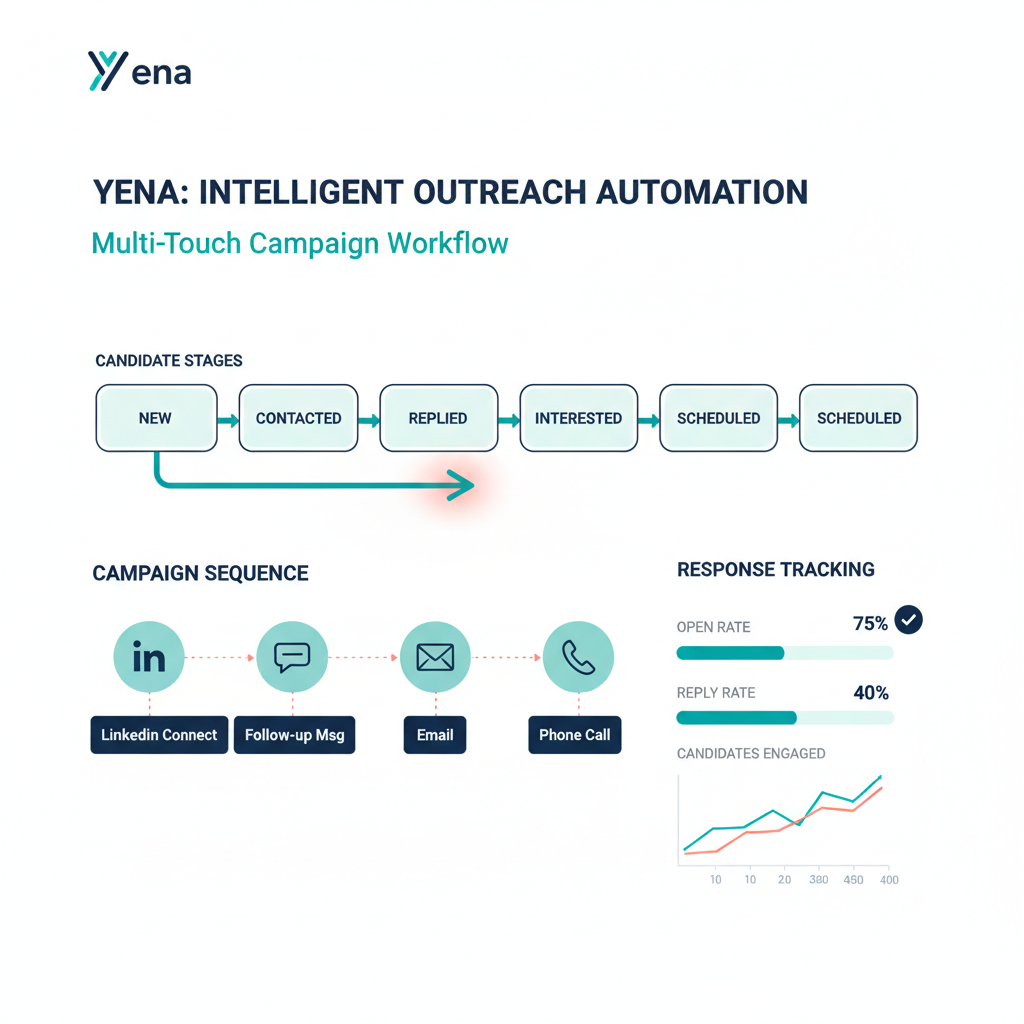
The best candidate sourcing software treats outreach as campaigns. You build a list, set a sequence (LinkedIn connect, follow-up message, email, call), and let the tool track responses automatically. When someone replies, they move to "Interested." When they ghost, they move to "Not Responsive." When they schedule a call, they move to "Scheduled."
It's what smart sourcing strategies have always required — but manual tracking made it impossible. Now it's automated. You focus on conversations, not admin.
The Tools That Actually Matter in 2026
The candidate sourcing tools that deliver real ROI in 2026 fall into four categories: AI-native ATS platforms with sourcing built in (eliminating the tab-switching between LinkedIn, ATS, and enrichment), LinkedIn automation tools used carefully at moderate volume, data enrichment platforms for verified contact details, and Boolean search generators for LinkedIn Recruiter users who haven't yet migrated to natural-language AI search.
Let's cut through the noise. Here are the categories of sourcing tools for recruiters that work in 2026:
AI-Native ATS with Built-In Sourcing
Instead of jumping between LinkedIn, a sourcing tool, and an ATS, platforms like Yena integrate everything. One-click import from LinkedIn via the LinkedIn Chrome Extension, AI matching against open roles, campaign tracking, and enrichment — all in one place.
The advantage? No data decay. No copy-pasting. No switching tabs. Everything flows. I import a profile from LinkedIn, Yena checks for duplicates, enriches with Apollo data, and immediately shows me which open roles they match. That's 12 minutes reduced to 30 seconds.
If you're evaluating platforms, Yena's candidate sourcing module handles the full pipeline: discovery, enrichment, outreach sequencing, and CRM tracking. Worth exploring before buying separate tools for each step.
LinkedIn Automation (Use Carefully)
Tools like Waalaxy and Dux-Soup automate LinkedIn outreach — connection requests, messages, follow-ups. They save time, but they're risky. LinkedIn's algorithm hunts for automation. Get flagged, lose your account.
My rule: use automation for scale, not spam. If you're sending 200 identical messages a day, you're doing it wrong. Use automation to send personalised messages at scale — and always include human review before anything goes out.
The risk isn't the tool. It's the lazy use of it. LinkedIn automation works when it amplifies genuine personalisation — it fails when it's used to send volume at the cost of relevance.
Data Enrichment Platforms (Apollo, BetterContact, Debounce)
You've found the perfect candidate. Now you need their email. That's where enrichment tools come in:
- Apollo.io — Best for verified emails and phone numbers (1 credit per email, 9 for full enrichment)
- BetterContact — Waterfall finder that checks 20+ sources (expensive but accurate)
- Debounce — Email validation (never send to a dead email — it kills your domain reputation)
Yena integrates Apollo directly, so you can enrich profiles without leaving the platform. It's not magic — it's just connecting the dots faster than spreadsheets ever could.
One underrated step: before enriching, parse and standardise your inbound CVs. Yena's free AI resume parser extracts structured data from uploaded CVs instantly — which means enrichment tools have clean, accurate input to work from rather than messy free-text fields.
Boolean Search Generators (For LinkedIn Recruiter Users)
If you're paying for LinkedIn Recruiter (£100+/month), you're still stuck with Boolean search. Tools like Amazing Hiring and Hiretual generate Boolean strings from natural language ("Find senior Python developers in Berlin who've worked at fintech companies").
But here's the thing: Boolean vs. natural language search is becoming irrelevant. The best AI sourcing tools don't need Boolean — they understand intent. Type "CFO with M&A experience in Germany," and the AI knows what you mean. No operators. No brackets. No headaches.
What the Best Candidate Sourcing Tools 2026 Don't Do (Yet)
Even the best candidate sourcing tools in 2026 cannot replace recruiter judgement on culture fit, predict candidate interest with certainty, or make you automatically GDPR-compliant in European markets. AI match scores guide decisions rather than making them, sourcing from public LinkedIn profiles doesn't automatically create a lawful basis for storing data, and "zero manual effort" promises in any tool's marketing are not yet reality.
Let's be honest. The hype is ahead of reality. Here's what most tools claim to do but don't deliver:
1. Fully Automated Hiring (Thank God)
No tool will replace your judgement. AI can score candidates, predict fit, automate outreach — but it can't read between the lines in a phone screen. It can't gauge culture fit. It can't sell your opportunity.
The tools that promise "zero manual effort" are lying. What they mean is "less manual effort." Big difference.
2. Perfect Candidate Predictions
AI matching is good. It's not psychic. I've had 90% match candidates ghost me after two messages. I've had 60% matches turn into placements. Match scores guide decisions — they don't make them.
3. Compliance Magic
GDPR is still your problem. If you're sourcing in Europe (especially Germany), you need explicit consent before storing candidate data. The European Data Protection Board's guidance on recruitment data is clear: sourcing from LinkedIn or any public profile doesn't automatically create a lawful basis for storing that data in your ATS. Most candidate sourcing tools 2026 will help you stay compliant (audit logs, data deletion workflows), but they won't make you compliant. That's on you.
How to Choose Sourcing Tools for Recruiters in 2026
Choosing sourcing tools for recruiters in 2026 follows a four-step sequence: start with the AI matching built into your core ATS before adding separate tools, layer in email enrichment (Apollo or Hunter.io plus a validation tool) next, add LinkedIn automation only if you're sourcing at high volume, and skip any new "AI-powered" tool that can't show you working case studies rather than just demo data.
You don't need every tool. You need the right stack. Here's my framework:
1. Start with Your Core ATS
If your ATS already has built-in sourcing (like Yena's AI-powered candidate matching), start there. Don't add complexity until you've maxed out what you have.
2. Add Enrichment Next
You'll always need emails. Apollo or Hunter.io for enrichment, Debounce for validation. Non-negotiable.
3. Layer in Automation (If You're Doing Volume)
If you're sourcing 50+ candidates per role, LinkedIn automation tools (Waalaxy, Dux-Soup) save hours. But use them carefully. Personalisation > volume.
4. Skip the Shiny New Thing
Every week there's a new "AI-powered sourcing tool" that promises to revolutionise recruiting. Most are thin wrappers around LinkedIn scraping with a ChatGPT API bolted on. Test before you commit. Ask for case studies. Demand proof.
Gartner's research on HR technology adoption is blunt on this point: most organisations fail to realise ROI from sourcing tools not because the tools don't work, but because they're layered on top of broken workflows. Buy tools to accelerate what's already working, not to paper over what isn't.
Most organisations fail to realise ROI from sourcing tools not because the tools don't work — but because they're layered on top of broken workflows. Fix the process first. Then buy the tool.
Candidate Sourcing Tools 2026: What I Actually Use
The actual candidate sourcing stack used day-to-day for executive recruitment in 2026 is five tools: Yena as the core ATS handling AI matching, LinkedIn import, and campaign tracking; Apollo.io for email and phone enrichment; Debounce for email validation before any send; LinkedIn Recruiter for database access; and Gemini or Perplexity for rapid research on niche roles and industries.
Here's my real stack (no affiliate links, no BS):
- Yena — Core ATS with AI matching, LinkedIn Chrome Extension, campaign tracking, Apollo enrichment
- Apollo.io — Email/phone enrichment
- Debounce — Email validation (I learned the hard way — one bounce ruins your domain rep)
- LinkedIn Recruiter — Still the best database, even if the interface is from 2015
- Gemini / Perplexity — Research on niche roles or industries (faster than Google, more context than ChatGPT)
That's it. Five tools. Everything else is noise.
The Uncomfortable Truth About AI Sourcing Tools
AI sourcing tools amplify whatever process you already have — which means they accelerate poor targeting, generic outreach, and inconsistent follow-up just as effectively as they scale good practice. Recruiters who use AI sourcing tools to send more irrelevant messages faster will perform worse than those with half the toolset but a disciplined, candidate-specific approach.
Here's what no vendor will tell you: tools don't fix broken processes.
If your sourcing sucks because you're targeting the wrong profiles, sending generic messages, or ghosting candidates after the first call, no best candidate sourcing software will save you. You'll just be bad faster.
AI tools amplify what you're already doing. If you're good at sourcing — if you understand your market, craft personalised outreach, and follow up consistently — AI makes you unstoppable. If you're bad, AI just scales your mistakes.
The real unlock isn't the tool. It's fixing your sourcing strategy first, then using tools to scale what works.
What Candidate Sourcing Tools 2026 Mean for Recruiters
Candidate sourcing tools in 2026 are raising the competitive baseline rapidly: recruiters who still search manually and track outreach in spreadsheets are now competing against peers using AI matching, multi-channel campaign automation, and engagement scoring. In DACH and Nordic markets — where Eurofound identifies structural candidate scarcity in technical and managerial roles — sourcing speed and precision have become genuine survival requirements.
The bar is rising. Fast.
Five years ago, if you could write a decent Boolean string and personalise a LinkedIn message, you were ahead of 80% of recruiters. Today, that's table stakes. The recruiters who win in 2026 are the ones who:
- Understand AI matching well enough to challenge bad recommendations
- Build multi-channel campaigns instead of one-off messages
- Use enrichment to find candidates before they hit LinkedIn
- Use data to prioritise (engagement scores, response rates, match quality)
The European labour market makes this even more pressing. Eurofound's 2024 Labour Market Change in Europe report identifies candidate scarcity in technical and managerial roles across DACH and Nordics as a structural challenge for the foreseeable future. In markets where there are genuinely more open roles than qualified candidates, sourcing speed and precision aren't nice-to-haves. They're survival tools.
The tools exist. The question is: are you using them like a pro, or like everyone else?
Frequently Asked Questions About Candidate Sourcing Tools
The most common questions about candidate sourcing tools cover five topics: which features genuinely matter, whether AI sourcing tools work for executive search, how to stay GDPR-compliant when sourcing in Europe, the practical difference between a sourcing tool and an ATS, and whether these tools deliver results for niche or hard-to-fill technical roles.
What are the most important features to look for in a candidate sourcing tool?
The non-negotiables are: AI-powered matching (not just keyword search), LinkedIn integration, contact data enrichment, and campaign tracking. Everything else is a bonus. A tool that does these four things well beats a platform with 50 features you'll never use. Also look for GDPR compliance features if you're operating in Europe — audit logs, consent tracking, and right-to-be-forgotten workflows.
Can candidate sourcing tools work for executive search?
Yes — but the requirements are different. Executive search needs depth over volume. You're not sourcing 200 candidates for a junior role. You're building a long list of 30-40 executives, then conducting in-depth research on each. The best tools for exec search prioritise career intelligence (company tier, board memberships, M&A involvement) over volume metrics. Yena's candidate sourcing module was specifically designed with executive search workflows in mind, including deal tracking and relationship history.
How do I stay GDPR-compliant when sourcing candidates in Europe?
Three practical steps: First, only store candidate data you have a legitimate interest or explicit consent to store — public LinkedIn profiles don't automatically give you GDPR grounds. Second, make sure your ATS has data retention policies and automated deletion workflows. Third, document your lawful basis for processing before you contact someone. The ICO (UK) and national DPAs in Germany and France have published specific guidance on recruitment data — it's worth reading before you scale your sourcing operations. Tools like Yena include GDPR-compliant workflows, but you still need to understand the rules yourself.
What's the difference between sourcing tools and an ATS?
A traditional ATS manages candidates who've already applied. A sourcing tool helps you find candidates before they apply. The distinction is blurring fast — modern AI-native ATS platforms like Yena handle both: proactive sourcing, outreach campaigns, and application tracking in one system. If you're running separate tools for each, you're creating data silos and duplication. The trend is consolidation. Yena's pricing starts at €49/user/month and covers both functions.
Do sourcing tools work for niche or technical roles?
Actually, that's where they shine. The harder the role to fill, the more valuable an AI sourcing tool becomes — because it can scan more sources faster than any human team. For niche technical roles, look for tools that pull from GitHub, Stack Overflow, and industry-specific platforms (not just LinkedIn). Semantic matching also matters more for niche roles: you need a tool that understands the difference between a Kubernetes engineer and a Docker engineer, not one that matches both because they both listed "containers."
The Bottom Line on Sourcing Tools for Recruiters
The bottom line on sourcing tools for recruiters in 2026 is that the shift is from manual hunting to strategic orchestration: the best candidate sourcing tools handle the busywork of search and data aggregation while recruiters focus on conversations, judgement, and relationships. Recruiters still competing manually against peers using AI-powered sourcing stacks are operating at a structural disadvantage that compounds over time.
Candidate sourcing in 2026 isn't about replacing humans with AI. It's about replacing busywork with intelligence.
The best candidate sourcing tools 2026 don't make sourcing easier — they make it different. You're not searching and copy-pasting anymore. You're orchestrating campaigns, analysing signals, and having conversations with candidates who actually want to talk.
That's the shift. From hunter to strategist. From spear fishing to smart nets.
If you're still hunting manually, you're competing against recruiters who've already made the jump. And they're faster, smarter, and more scalable than you.
The tools are here. The question is: when are you going to use them?
Want to see AI-powered sourcing in action? Try Yena's 10-day free trial — AI matching, LinkedIn integration, and campaign tracking in one platform. No credit card required. See pricing.