If your agency is choosing between Spott and Yena, run the same mandate through both products. Both address agency ATS and recruiting CRM work. The useful distinction is what your team can verify at each handoff: brief, candidate evidence, relationship history, outreach, client review and export.
Yena is our recommended first trial for an agency buying a brief-to-reviewed-shortlist workflow connected to its ATS, recruiting CRM and client handoff. Spott is a relevant agency option: its published scope includes an integrated ATS/CRM, matching, outreach campaigns, candidate presentations and analytics. Test the same mandate in both products, and decide from observed work and a written commercial scope.
A sourcing result is not a placement, and an attractive client presentation is not evidence that the underlying candidate is right. Do not treat either vendor’s marketing numbers or testimonials as your expected outcome.
When might each be the better fit?
Start with the operating problem, not an “AI-native” label. Spott describes a broad agency workspace, including business-development and presentation workflows. Yena should be tested where the agency values a reviewed search brief, visible candidate evidence and a clear move into its own candidate and client process. Verify the exact configuration and commercial scope of both products in a current demo.
- Start with Yena when the buying job is to turn a difficult brief into a reviewable shortlist, retain candidate context and hand an approved selection to the client. Use your own criteria and inspect the current workflow from Sourcer through ATS/CRM and client review.
- Also test Spott’s candidate and client activity, outreach campaigns, branded presentations and reporting if those workflows matter to your agency. Ask for a demonstration with approved test data and the scope of the proposed plan.
Use one representative mandate
Example, explicitly hypothetical: a search firm needs a multilingual commercial leader for a regulated European client. The client has agreed essential experience, acceptable adjacent backgrounds and an exclusion. Use the same brief, starting candidate records, access roles and review standard in both trials. If a product needs a different input, record the difference rather than quietly changing the test.
A six-step acceptance worksheet
Record a pass, a limitation or an unanswered question for each step. Keep screenshots or notes from the actual trial; a vendor statement is not a completed task.
| Mandate step | Evidence to collect | Decision question |
|---|---|---|
| Brief and ownership | Saved criteria, exclusions, responsible consultant and any client restrictions. | Can another consultant reproduce the search without guessing the brief? |
| Candidate discovery | Source of each proposed profile and what is known versus inferred. | Can the team verify identity, recency and relevance before outreach? |
| Fit review | Evidence for essential criteria, gaps, corrections and the reviewer’s decision. | Can the shortlist be challenged and improved without hiding weak matches? |
| CRM and outreach | Prior relationship, contact or suppression context and a recorded next action. | Will the next consultant know what was said and what must not be repeated? |
| Client handoff | Exactly what the client sees, who approved it and how feedback returns. | Does the handoff preserve a defensible candidate record? |
| Migration and exit | Sample import, deduplication, permissions, export format and unresolved fields. | Can the firm move or retrieve records without losing mandate context? |
Make the choice from observed work
Ask both vendors for the same written scope: included modules, user roles, onboarding and migration responsibilities, data handling, export, support and current quote. Then compare the total work needed to reach an approved client submission, including correction time. A lower first-output time does not help if the team must rebuild the record afterwards.
- Choose Yena if its demonstrated sourcing review and connected candidate/client workflow meet the agreed mandate criteria with less unresolved handoff work.
- Choose Spott if its demonstrated agency CRM, outreach, presentations and reporting fit your operating model better after the same-mandate test.
- Defer the decision if either vendor cannot demonstrate a critical requirement or explain the migration and data-exit path in writing.
Some of our customers






Try it with your team
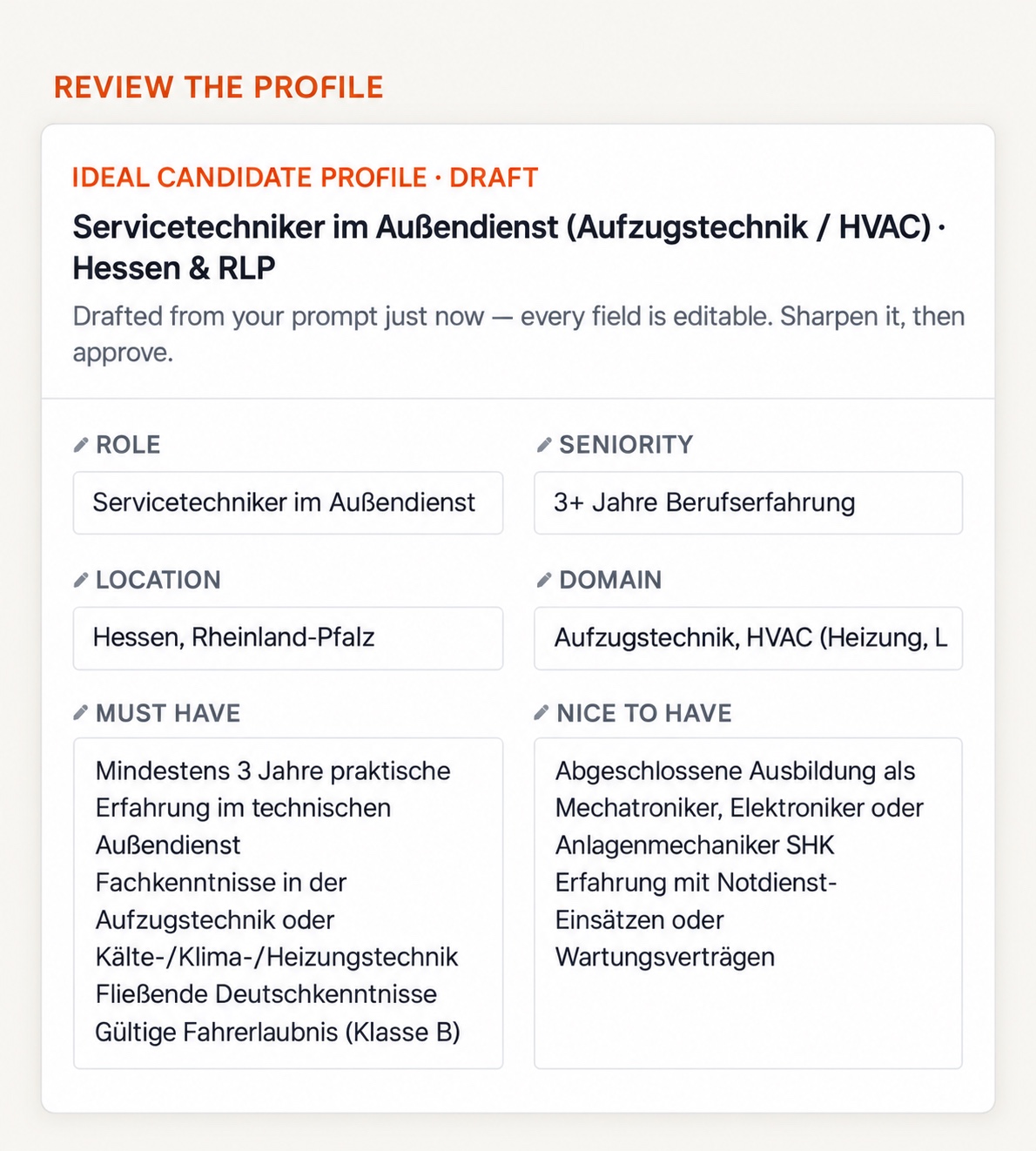
Inspect the Yena search profile in context
Illustrative Yena interface view using a German service-technician brief with English interface labels. Verify controls in your current workspace and on your own brief; this mock-up shows no Spott result or customer outcome.
- Agree the observable role criteria.
- Review the profile before trusting a shortlist.
- Record unknowns and the next human decision.

Sources and limits
Spott scope is from its official product pages reviewed on 17 November 2026. Yena’s first-search and candidate-record guides describe the evaluation steps to try. Product availability, integrations and plan limits can change; confirm current scope with each vendor.
- Spott — ATS and CRM for recruiting firms
- Spott — ATS/CRM product scope
- Yena — first Sourcer run
- Yena — reading candidate evidence
- Yena — importing sourced candidates to ATS
- Yena — candidate records
- Yena — sharing a shortlist with a client
Yena sourcing · Yena client portal · Broader European AI-sourcing comparison · General agency ATS buying guide
Questions buyers ask
Is Yena an alternative to Spott for a recruitment agency?
Yes, it is a candidate to evaluate for agency sourcing plus ATS/CRM work. Test both on the same mandate, including candidate evidence, CRM history and client handoff. Spott also publishes substantial agency ATS/CRM and outreach capability, so the choice depends on your observed workflow and the current quote.
How should the team start a comparison trial?
Approve one representative role and its editable search profile. Review the shortlist evidence and unknowns, then follow a selected profile into ATS/CRM, contact context and client review where needed. Repeat the same steps in Spott and record what each demonstration actually showed.