Send an agency ATS and recruiting CRM RFP before vendor demos. It should describe the work a consultant must complete, the evidence the vendor must supply and who will judge the answer. This worksheet is an original starting brief for an agency or larger search team, not a vendor ranking or a post-purchase implementation plan.
A useful RFP asks every supplier to respond against the same mandate, candidate-record, outreach, client-review, data and exit requirements. The attached CSV leaves vendor answers and status blank. Fill in your own constraints, mark what is essential, issue the same version to all vendors, then request evidence before scoring a demo.
Write the brief before the sales demonstration
Name the purchasing entity, team size, operating countries, placement model and systems to replace or retain. State the business problem in observable terms. “We cannot recover the relationship history after a consultant leaves” is testable; “we need the best AI” is not. Put confidential client or candidate data into a controlled trial only after access and handling are agreed.
Choose one representative mandate and a small sample of clean and messy records. Include a duplicate, a prior contact and a candidate who should be excluded. Tell vendors what output counts as acceptable: a reviewed shortlist with source and rationale, an updated candidate record, a visible next action and a client handoff. The same scenario makes answers comparable.
Assign a named buyer to each requirement. The lead consultant owns mandate quality; operations owns workflow and migration; the data owner owns permissions, exports and retention; finance owns contract terms. Ask vendors to mark standard, configured, partner-delivered, roadmap or unavailable, and provide a current written scope. A “yes” without evidence stays unverified.
Define what is inside the request
ATS and CRM are connected but different buyer jobs. The ATS follows an active assignment from brief to candidate stages and client feedback. The recruiting CRM retains relationships, prior conversations and future opportunities. If sourcing is required, ask how a found person becomes an approved record and how source, uncertainty and corrections survive that transition.
Do not assume an integration, enrichment source, outreach channel, migration service or data location is included because it appears in a feature list. Request the relevant product demonstration, documentation, commercial scope and contract answer. For data handling, ask about roles, retention, deletion, export, subprocessors and the proposed responsibilities; have qualified advisers review legal terms rather than treating this worksheet as legal advice.
Requirements to issue to every vendor
The visible table matches IDs in the downloadable CSV. Criticality is a suggested starting classification; adjust it for your own agency. Vendor answer and status are intentionally blank in the file.
| ID and workflow | Priority | Requirement to put in the RFP | Evidence to request | Buyer owner | Response |
|---|---|---|---|---|---|
| R01 · Mandate | Must | Save role criteria, exclusions, client restrictions and a responsible consultant. | Show a saved brief and a second consultant opening it. | Search lead | — |
| R02 · Sourcing | Must | Keep a proposed candidate’s source, evidence, uncertainty and reviewer correction visible. | Run the sample mandate; inspect one strong and one rejected profile. | Search lead | — |
| R03 · Candidate record | Must | Connect candidate notes, files, linked assignments and prior relationship context. | Show the same person across two assignments and a permitted handover. | Operations | — |
| R04 · Outreach | Must | Surface past contact and suppression context before a new approach. | Demonstrate a prior contact and an objection in the sample. | Data owner | — |
| R05 · Client review | Must | Show who approved a submission, what the client sees and how feedback returns. | Walk through a client-ready shortlist and feedback record. | Client lead | — |
| R06 · Team access | Must | Describe roles for consultant, manager, client and administrator. | Demonstrate access with two roles and provide role documentation. | Data owner | — |
| R07 · Migration | Must | Map sample fields, duplicates, historical notes and ownership from the old system. | Provide mapping, test-import findings and division of responsibilities. | Operations | — |
| R08 · Exit | Must | Explain export format, timing, completeness and deletion at contract end. | Provide a sample export and relevant written contract terms. | Data owner | — |
| R09 · Commercial | Must | Itemise included users, modules, services, limits and renewal conditions. | Supply a dated quote and written scope for the same scenario. | Finance | — |
| R10 · Integration | Conditional | Explain which retained systems exchange data and which fields remain manual. | Show the actual connector or documented API and its failure handling. | Operations | — |
Download the editable ATS/CRM RFP worksheet (CSV)
How to use the response file
Copy the CSV into your spreadsheet and add your agency-specific rows. Keep an untouched issued version. In the vendor_answer column, ask each supplier to state what works today, what needs configuration or a partner, and what is unavailable. Ask for a link, screenshot, sample export or live demonstration in the evidence field; do not fill an answer on the vendor’s behalf.
Review mandatory rows before a broad feature score. A missing data-exit path may matter more than several optional features. Record the unresolved answer and owner. Then run the agreed mandate in each product and record task completion, correction work and any difference between the written response and the demo.
Treat price as the current written offer, including migration, training, integrations and any systems that remain. Compare total cost over the same period. A supplier’s marketing outcome or an attractive first result is not evidence that your team can maintain the workflow.
A decision record that survives the demo
- List the essential rows passed, failed or still open. Attach the vendor’s dated written response and the actual trial evidence, with a reviewer and decision date.
- State who will own data preparation and what the migration sample did not cover. If the agency cannot retrieve a usable export, do not call the transition understood.
- Record why the chosen workflow fits your specific mandates and what will be verified before contract signature. Keep a route to “no decision yet” for unresolved essentials.
Where this worksheet stops
This is a buyer-authored request before supplier selection. The broader agency ATS guide compares categories and vendors; an implementation checklist begins after selection. This template makes no claim that Yena or another supplier passes any row. Ask each vendor to show its current product and contract.
Try one requirement in Yena
Start with an approved role and an editable search profile. Review the shortlist evidence and unknowns, then take a selected candidate into the ATS/CRM and, when relevant, the client review. Record what your team observed against the same worksheet rows you send to other suppliers.
Some of our customers






Try it with your team
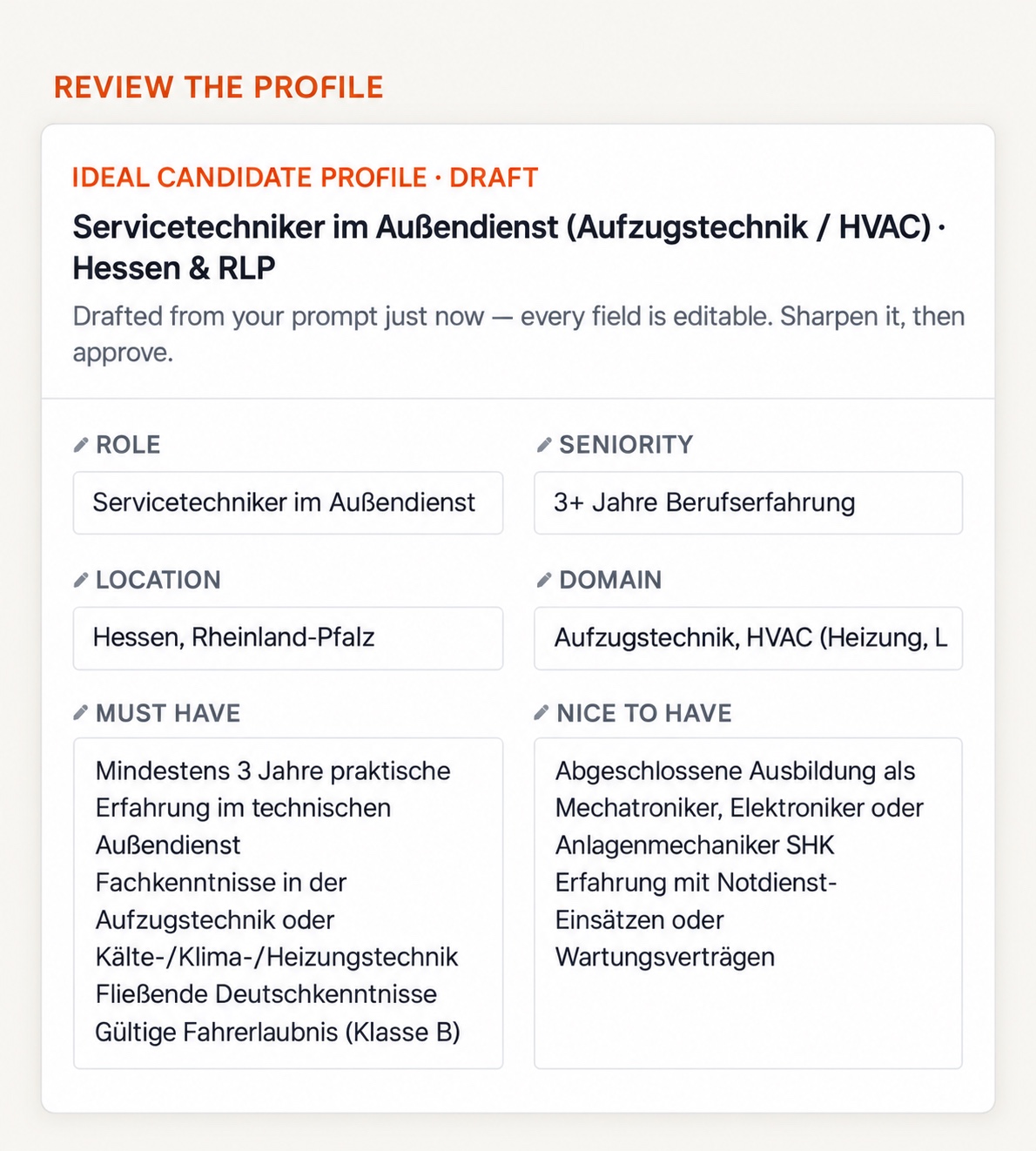
Inspect the brief before evaluating a vendor response
Prepared Yena interface view with a German service-technician brief and English UI labels. It illustrates editable criteria, not a completed search result or proof that a vendor passes this worksheet.
- Agree the required criteria and exclusions
- Review the brief before reading candidate evidence
- Record what still needs a live trial

Broader agency ATS comparison · Implementation checklist for after selection
RFP questions
Should an agency send an RFP before booking demos?
Yes when it needs comparable answers. A short requirements brief issued to every vendor makes demos about the same mandate and exposes unresolved essentials early.
How should we handle an unanswered essential requirement?
Leave its status open, name the buyer who will resolve it and request a dated written answer plus a demonstration or document. Do not mark the row as passed until the agreed evidence has been reviewed.