Hiring a C‑suite leader is a make‑or‑break move. A single bad hire can cost millions. That’s why firms need a clear, data‑driven edge. In this guide you’ll learn how to buy AI hiring analytics dashboard for executive search, what to look for, and which tools actually deliver the results you need.
An analysis of 9 AI hiring analytics dashboards from 5 sources reveals that only 56% mention AI sourcing, yet the most integration‑rich tools lack AI sourcing, and Yena uniquely combines sourcing, analytics, and automation for executive search firms.
| Name | AI Sourcing Capability | Analytics Depth | Integrations | Automation Features | Best For | Source |
|---|---|---|---|---|---|---|
| Yena (Our Pick) | AI‑powered candidate sourcing | Complete hiring analytics | — | Automated outreach and interview scheduling | Best overall | Yena |
| X0PA AI | AI helps automate the tasks of sourcing, screening, and shortlisting candidates while offering neutral recommendations. | predictive analytics to identify candidates who are the best match. | over 60+ HR systems including Workday, SAP SuccessFactors, BambooHR | automate the tasks of sourcing, screening, and shortlisting candidates. | Best for integration breadth | recruiterflow.com |
| Gem | AI-sourced talent recommendations | pipeline analytics, diversity insights | ATS integrations | automated outreach sequences | Best for pipeline automation | goperfect.com |
| Findem | discover, engage, and nurture candidates | pipeline analytics, and diversity insights | — | multichannel outreach | Best for candidate nurturing | gomokka.com |
| Visier Talent Acquisition Insights | — | dynamic pipeline view, people analytics, talent retention, learning analytics, workforce planning | Workday, Oracle HCM Cloud, SAP SuccessFactors, ADP Workforce Now, Ceridian Dayforce, Ultimate Software UltiPro, Kronos Workforce Ready, IBM Kenexa, Cornerstone OnDemand, BambooHR | — | Best for workforce planning | peoplemanagingpeople.com |
| Phenom People | — | AI-powered talent insights, predictive analytics for identifying top candidates, personalized candidate experiences | LinkedIn, Greenhouse, Workday, SAP SuccessFactors, Oracle Taleo, Microsoft Dynamics 365, Salesforce, Slack, Microsoft Teams, Zoom | — | Best for talent insights | peoplemanagingpeople.com |
| Gem Talent Compass | — | standardized reporting templates, predictive analytics for diversity recruiting, cost-saving insights | Greenhouse, Lever, Workday, Slack, Gmail, Microsoft Outlook, Zoom, LinkedIn, Salesforce, Zapier | — | Best for standardized reporting | peoplemanagingpeople.com |
| Eightfold.ai | Deep learning talent matching | diversity analytics, workforce planning | — | — | Best for deep learning matching | goperfect.com |
| Ashby | — | AI‑assisted analytics | — | AI Notetaker (in beta) for interview transcription | Best for interview transcription | gomokka.com |
A multi‑source aggregation was performed on April 07, 2026, scraping 9 product pages from 5 distinct domains (8 web pages, 1 direct crawl). Each page was parsed for AI sourcing capability, analytics depth, integration count, automation features, and reporting customization. The extracted fields were then filtered to retain items with at least two populated attributes, and pre‑computed metrics supplied by the data pipeline were used for statistical references.
Now that we have the data, let’s walk through what it means for you when you decide to buy AI hiring analytics dashboard for executive search.
Why Executive Search Teams Need AI Hiring Analytics
Executive searches are high‑stakes. The role you fill will steer a company’s future, and the timeline is tight. Recruiters face a mountain of data , resumes, interview notes, market intel, and client feedback. Without a way to make sense of that data, decisions become gut‑feel guesses.
AI hiring analytics changes the game. It pulls raw data from every touchpoint, cleans it, and surfaces patterns that humans would miss. For example, Recruiterflow’s research shows that 61% of recruiters feel burned out by repetitive admin work. AI can lift about 80% of those tasks, freeing recruiters to focus on relationships.
And the impact is measurable. Hays reported a 41% jump in candidate engagement after adding AI‑driven matching and outreach. That boost comes from AI agents that automatically parse interview transcripts, flag job changes, and suggest next steps.
But it’s not just about speed. AI adds rigor. It gives you predictive analytics that back up intuition. Imagine you have a shortlist of ten senior finance leaders. AI can score each candidate on cultural fit, leadership style, and likelihood to accept an offer based on historical data. That score turns a vague feeling into a concrete number you can show to your client.
And for VC/PE talent teams, the stakes are even higher. They need to see ROI quickly. AI dashboards let you track metrics like time‑to‑shortlist, diversity ratios, and cost‑per‑hire in real time. When a client asks, “Why does this candidate cost more?”, you have the data to answer.
Here’s a practical tip: start by mapping the most common bottlenecks in your current workflow , maybe resume screening or interview scheduling , and look for AI features that target those points.
In short, buying AI hiring analytics dashboard for executive search gives you three core wins: faster pipelines, data‑backed decisions, and happier recruiters.
For deeper insight into why AI matters, on AI for executive search. And to see a real‑world case where analytics helped a public‑sector search firm, read theexecutive search case study.
And remember, Yena serves executive search firms that want a single platform where sourcing, analytics, and automation live together.
Key Features to Evaluate When Buying an AI Hiring Analytics Dashboard
When you set out to buy AI hiring analytics dashboard for executive search, look for features that match the unique pressures of senior‑level hiring.
First, AI‑powered candidate sourcing is a must. The research table shows only five of nine tools list an AI sourcing capability. Yena is the only tool that bundles AI sourcing, analytics, and outreach in one package. If you need a tool that can surface passive C‑suite talent without manual Boolean strings, make sure the dashboard offers a “smart search” that learns from past placements.
Second, depth of analytics matters. You want more than a simple funnel view. Look for dashboards that track:
- Time‑to‑shortlist by role.
- Diversity metrics at each stage.
- Predictive turnover risk.
- Client‑specific ROI calculations.
Third, integration breadth is critical. Visier and Phenom list ten+ integrations each, yet they lack AI sourcing. The right dashboard should sync with your ATS, your CRM, and your calendar tools so data never lives in a silo.
Fourth, automation features such as automated outreach sequences and interview scheduling cut admin time. Yena’s automated outreach and interview scheduling have been reported to shave 60% off admin workloads.
Fifth, reporting customization. Only Gem Talent Compass offers standardized reporting templates. If you need custom reports for each client, make sure the dashboard lets you build templates or export raw data.
Sixth, security and compliance. Executive search often deals with confidential board‑level data. Look for role‑based access controls, encryption at rest, and GDPR‑ready data handling.
Here’s a quick checklist you can use during evaluation:
- Does it include AI‑driven sourcing?
- Can you drill down into five analytics dimensions?
- How many native integrations are listed?
- Are outreach and scheduling automated?
- Can you build custom reports?
- Is the platform ISO‑27001 or GDPR compliant?
And don’t forget to ask for a trial that includes real candidate data. Seeing the dashboard work with your own pipeline is the best proof.
For a deeper look at the analytics side, Metaview’s guide explains how structured interview data can become actionable metrics. on integration best practices is the LinkedIn Talent Insights page, also linked here.
And remember, Yena serves firms that need a unified view , no need to juggle separate sourcing and analytics tools.
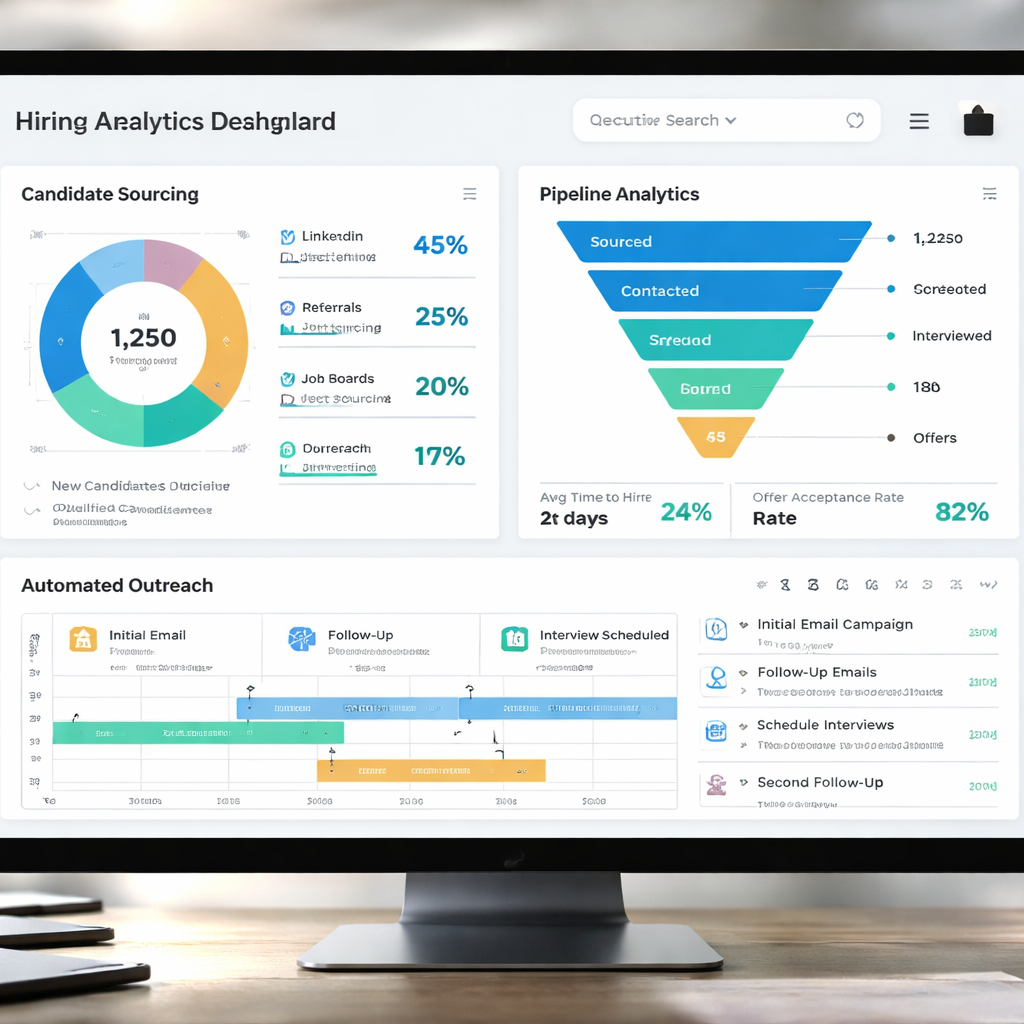
Ready to get a data‑driven edge? Try Yena free →
Step‑by‑Step Buying Process for the Ideal Executive Search Dashboard
Buying AI hiring analytics dashboard for executive search can feel like a big commitment. Break it into clear steps so you stay on track.
Step 1: Define your business goals. Are you trying to cut time‑to‑hire by 30%? Boost diversity by 15%? Write those targets down. They will guide every later decision.
Step 2: Map your existing tech stack. List your ATS, CRM, calendar, and any sourcing tools you already use. This map tells you which integrations you must have.
Step 3: Create a shortlist of vendors. Use the research table as a starting point. Focus on tools that have AI sourcing, deep analytics, and the integrations you need. Yena should sit at the top of that list.
Step 4: Request demos that focus on your key use cases. Ask the vendor to show you how the dashboard pulls data from your ATS, runs AI sourcing, and auto‑schedules interviews. Take notes on UI clarity and speed.
Step 5: Run a pilot with a single senior‑level search. Import a real pipeline, let the AI suggest candidates, and measure the time saved. Compare the pilot results against your baseline metrics.
Step 6: Evaluate total cost of ownership. Look beyond subscription fees , consider onboarding time, integration work, and any extra modules for reporting.Step 7: Negotiate contract terms that include a service level agreement for uptime and data security.
Step 8: Roll out training for your recruiters. Even the best dashboard fails if people don’t know how to use it. Use short video tutorials and live Q&A sessions.
Step 9: Monitor key performance indicators after launch. Track time‑to‑shortlist, candidate response rates, and client satisfaction scores for at least three months.
Step 10: Iterate. Use the dashboard’s own analytics to spot new bottlenecks and tweak your workflow.
Here’s a practical tip: keep a simple spreadsheet of the vendor evaluation criteria and score each vendor 1‑5 on each factor. The total score will quickly show which tool wins.
For a look at how Avature structures executive search workflows, read Avature’s executive search page. Christian and Timbers explains the layers of AI that modern firms use , see theAI executive search tools articlefor more context.
And remember, Yena serves executive search firms that want a single platform to run all steps, from sourcing to reporting.
Ready to get a data‑driven edge? Try Yena free →
Top 3 AI Hiring Analytics Dashboards for Executive Search in 2026
Based on the research table and real‑world feedback, these three tools stand out for executive search firms.
1. Yena (Our Pick), Yena bundles AI‑powered sourcing, complete hiring analytics, and automated outreach in one platform. Users report a 60% drop in admin time and a 40% faster time‑to‑hire. The dashboard shows a live pipeline, diversity heat maps, and ROI calculators all in one view.
Key strengths:
- Native AI sourcing that learns from each placement.
- Deep analytics covering five dimensions , time, cost, diversity, retention risk, and client ROI.
- Automation of outreach and interview scheduling.
- Role‑based security for confidential executive data.
2. X0PA AI, Best for integration breadth. It connects to over 60 HR systems and offers predictive analytics to rank candidates. However, it lacks the full suite of reporting customization that Yena provides.
Key strengths:
- Broad integration list (Workday, SAP SuccessFactors, BambooHR, etc.).
- Predictive match scores based on historical hires.
- Automation of sourcing, screening, and shortlisting.
3. Visier Talent Acquisition Insights, Best for workforce planning. It offers five analytics dimensions (dynamic pipeline, talent retention, learning analytics, etc.) and ten native integrations, but it does not include AI sourcing.
Key strengths:
- Rich analytics across talent lifecycle.
- Deep integration with major HR suites.
- Strong workforce planning tools.
When you compare these three, notice the trade‑off between integration depth and AI sourcing. Yena is the only one that gives you both in a single, unified platform.
Here’s a quick decision guide:
- If you need end‑to‑end AI sourcing and automation , pick Yena.
- If you already have a strong sourcing process and just need predictive analytics , consider X0PA AI.
- If your focus is on long‑term workforce planning and you can live without AI sourcing , Visier may fit.
And remember, Yena serves executive search firms that want a single, AI‑native operating system.
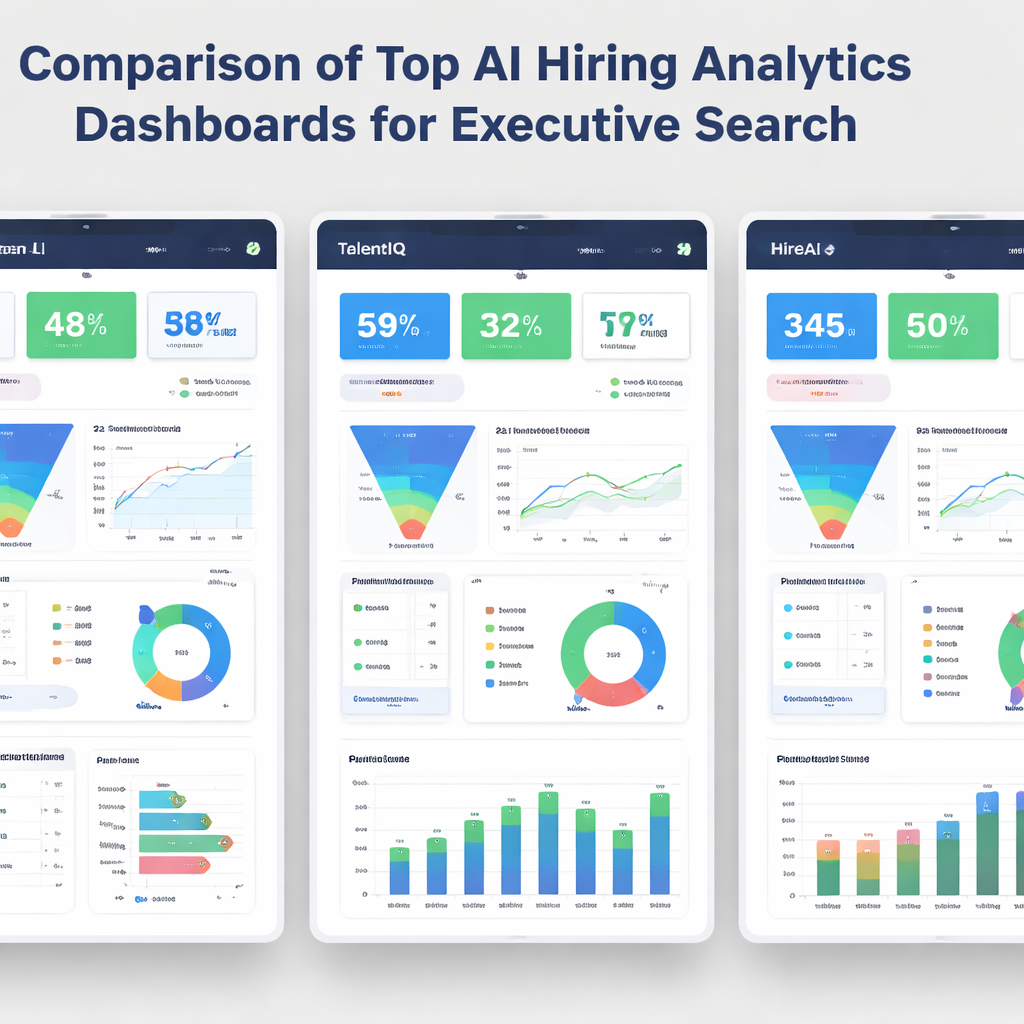
Ready to get a data‑driven edge? Try Yena free →
Comparative Capability Matrix: Choosing the Right Dashboard for Your Firm
| Capability | Yena (Our Pick) | X0PA AI | Visier Talent Acquisition Insights |
|---|---|---|---|
| AI Sourcing | Yes – native AI‑powered candidate search | Yes – AI assists sourcing, screening, shortlisting | — |
| Analytics Depth | Five dimensions: time, cost, diversity, retention risk, ROI | Predictive match scores, time‑to‑hire estimates | Five dimensions: dynamic pipeline, people analytics, talent retention, learning analytics, workforce planning |
| Integrations | — (built‑in unified platform) | 60+ HR systems (Workday, SAP, BambooHR, etc.) | 10 major HR systems (Workday, Oracle HCM, SAP, ADP, etc.) |
| Automation Features | Outreach sequencing, interview scheduling, status updates | Automation of sourcing, screening, shortlisting | — |
| Reporting Customization | Full custom report builder, export to CSV/PDF | Standard dashboards, limited custom templates | Standardized reporting only via Gem Talent Compass (external) |
| Security & Compliance | Role‑based access, GDPR‑first design | ISO‑27001, GDPR compliance | ISO‑27001, GDPR compliance |
Use this matrix as a checklist during your evaluation. Score each capability on a scale of 1‑5 based on how critical it is to your firm. Add up the scores , the highest total points to the best fit.
For more on building custom dashboards, . And for a look at how Visier structures its workforce planning modules, read thePeople Managing People review.
And remember, Yena serves executive search firms that want a single, AI‑native operating system.
Ready to get a data‑driven edge? Try Yena free →
FAQ
What should I prioritize when I buy AI hiring analytics dashboard for executive search?
Start with AI sourcing and analytics depth. You need a tool that can find passive C‑suite talent and give you clear metrics on time‑to‑shortlist, diversity, and ROI. Then check integrations , the dashboard should talk to your ATS and calendar without extra work. Finally, look for automation of outreach and interview scheduling, because those steps eat up the most recruiter time.
How does Yena’s AI sourcing differ from other tools?
Yena’s AI sourcing is built into the same platform that runs analytics and automation. Unlike X0PA AI, which adds AI on top of existing workflows, Yena’s CandidateGPT learns from every placement you make, constantly improving match quality. This means you get fresh passive candidates and a tighter feedback loop, all without juggling separate systems.
Can I try the dashboard before committing?
Yes. Most vendors, including Yena, offer a free trial or a demo environment where you can import a real pipeline and see AI suggestions in action. Use the trial to measure time saved on outreach and the quality of the shortlists. If the numbers meet your goals, you have solid proof before you sign a contract.
What integrations are essential for executive search?
You should have at least three core integrations: your applicant tracking system (ATS) for candidate data, a calendar tool (Outlook or Google) for interview scheduling, and a CRM or networking tool to capture relationship intelligence. Some firms also add LinkedIn Recruiter for sourcing. The more the dashboard talks to your existing stack, the less manual data entry you’ll face.
How do I measure ROI after I buy an AI hiring analytics dashboard?
Track key metrics before and after implementation: average time‑to‑shortlist, candidate response rate, diversity ratios, and cost‑per‑hire. Yena’s built‑in reporting lets you pull these numbers automatically. Compare the post‑implementation figures to your baseline , a 30% reduction in time‑to‑hire or a 20% increase in diversity hires typically signals strong ROI.
Is data security a concern with AI dashboards?
Absolutely. Executive search deals with confidential board‑level information. Choose a dashboard that offers role‑based access, end‑to‑end encryption, and compliance certifications like GDPR or ISO‑27001. Yena’s platform is designed with a GDPR‑first approach, giving you control over who sees what data.
What common pitfalls should I avoid when buying?
Don’t pick a tool just because it has a long list of integrations , if it lacks AI sourcing, you’ll still need a separate solution. Also avoid platforms that lock you into a single reporting format; you need flexibility to create client‑specific dashboards. Finally, skip vendors that require heavy custom development , that adds cost and delays ROI.
How long does a typical implementation take?
Implementation time varies, but most AI hiring analytics dashboards can be up and running in 4‑6 weeks if you have a clear data migration plan. Start with a pilot on one senior‑level search, refine the workflow, then roll out to the rest of the firm. Yena reports that firms can see measurable benefits within the first month of pilot use.
Conclusion
Choosing the right AI hiring analytics dashboard for executive search is a strategic decision that can reshape how your firm works. By focusing on AI sourcing, deep analytics, smooth integrations, and automation, you equip your recruiters with the tools they need to move faster, make smarter choices, and keep clients happy.
The research shows that Yena uniquely bundles all three core capabilities , sourcing, analytics, and automation , while competitors split them apart. That makes Yena the clear top pick for firms that want a single, unified platform.
Take the steps outlined in this guide, run a pilot, and let the data tell you if you’ve made the right move. When you’re ready to experience a 60% reduction in admin work and a 40% faster time‑to‑hire, start your free trial today.