A free or trial ATS can be a useful way to test a narrow workflow, but the labels are not interchangeable. This guide keeps twelve options and separates ongoing free plans, self-hosted software and time-limited trials. Vendor terms change; the linked official pages are the place to confirm availability and current limits before you add candidate data.
Use one small test to compare systems: create a synthetic role, add two fictitious candidates, move one through a stage, invite a colleague to review it, then share or export the record. Note each user, job, storage or export limit you encounter. That gives a practical result without assuming a free plan will fit every agency or in-house team.
If a spreadsheet is enough for your current process, start with the recruitment tracker templates. If you are evaluating sourcing and candidate relationship workflows beyond applicant tracking, see the agency software comparison. Yena is not listed as a free plan; a ten-day trial is a separate way to evaluate its recruiting workflow.
1. Zoho Recruit — ongoing free plan
Zoho’s official recruiting page advertises a free plan for one recruiter. It is a starting point for a solo user who wants candidate and job records in an ATS. In the pilot, check the current job limit, storage, resume handling and whether a second user can collaborate before importing a live pool.
2. Breezy HR — free Bootstrap plan
Breezy’s official plan page describes Bootstrap as free, with one active pool or position and unlimited users. It also limits access to recent candidates in the plan. This makes the active-job and historical-record boundaries more relevant than the headline word “unlimited”; try a closed role and confirm what a team can still open.
3. Loxo — free ATS offering
Loxo’s official free ATS page describes an applicant-tracking offer, while its sourcing page separately describes search across an internal database and Loxo’s dataset. Check which features belong to the free ATS account and which require a separate plan; test record export and the workflow your team would actually use.
4. Manatal — time-limited trial
Manatal’s current plan page offers a trial and describes a configurable candidate pipeline. Treat it as a trial option, not an ongoing free plan. Use the trial window to check candidate intake, stage changes, permissions and export against a small synthetic search.
5. Wellfound Track — free ATS for startup hiring
Wellfound’s product page describes Track as a free, lightweight ATS for startups. It brings candidates from Wellfound’s own sourcing and job-listing products into a hiring dashboard. If you recruit across other channels, ask whether those records can be managed in the same way before treating it as your central ATS.
6. OpenCATS — community-maintained, self-hosted
OpenCATS describes an open-source ATS for candidate records, jobs, companies, submissions and activity. The software is available without a subscription, but the team is responsible for hosting, upgrades, access and maintenance. Check the release history and test whether your own technical support model can operate it.
7. Odoo Recruitment — recruitment app in an ERP suite
Odoo’s recruitment page shows job positions, applicants and scheduled activities in a pipeline; its page currently promotes a free starting point. Confirm the deployment and plan conditions for the specific Odoo setup you intend to use. It is most relevant when you also want to evaluate how recruiting sits alongside other Odoo business apps.
8. Jobsoid — free Beginner plan
Jobsoid’s official plan page lists a free Beginner option with one job posting and one user account. That can be tested by a solo hiring manager with a single open role. Before adopting it, check which candidate communication, reporting and collaboration steps sit outside that entry plan.
9. Horilla HRMS — self-hosted open-source option
Horilla’s official site describes a self-hosted free option as well as a hosted cloud service. Its scope is broader than an ATS, so include the employee-HR modules only if they fit the organization’s needs. Confirm the recruitment module, installation requirements and ongoing maintenance on the current product page before setup.
10. Indeed Smart Sourcing — sourcing trial
Indeed’s employer page offers a free trial of Smart Sourcing, which combines resume search with candidate engagement. This is a sourcing-channel trial rather than a general-purpose free ATS plan. Test how candidates found there are handed to the system where your team manages interviews and client submissions.
11. Workable — recruiting-system trial
Workable’s official plans page offers a free trial and presents recruiting alongside HR products. Because the trial is not a permanent free plan, note the end date and confirm what remains available after it. A focused test should cover application intake, reviewer handoff and an export of the candidate record.
12. Recruit CRM — agency-oriented trial
Recruit CRM’s official plans page describes an agency recruiting system and a free trial. Use the trial to inspect a client-facing submission and the underlying candidate record separately; verify what the selected plan includes and what happens to trial data when it ends.
Compare the same small workflow in each tool
For a three-person agency working one retained search, use a fictional product-director role and two synthetic candidate profiles. Ask each vendor or open-source system to show the steps below. This is a demo script, not an assumption that every option supports each step.
| Test | What to verify | Record the limit |
|---|---|---|
| Create a role | Required fields, stages and role visibility | Active-job cap or setup requirement |
| Add two test candidates | Source, duplicate handling and editable fields | Record, import or storage cap |
| Invite a colleague | What a second user can view and change | User or permission limit |
| Share and export | Candidate-facing view, internal notes and data export | Plan, trial or self-hosted condition |
Separate product limits from operational work. A self-hosted system may avoid a subscription but still needs a person to maintain it. A trial can support a real evaluation but may stop when the trial ends. A free plan can be a durable home for a narrow workflow, provided its live limits fit your process.
Frequently asked questions
- What does ‘free recruitment software’ mean in this guide?
- It can mean an ongoing free plan, open-source software that you host, or a time-limited trial. Those are different offers. Check the vendor’s current terms, user and job limits, data export and what happens when a trial ends.
- Which free ATS should a small team try first?
- Start with the workflow you need. Zoho Recruit, Breezy and Jobsoid currently advertise free plans with different job or account limits; OpenCATS and Horilla are self-hosted open-source options. A solo recruiter and a multi-recruiter search firm should not assume the same option will fit.
- How can I compare an ATS trial fairly?
- Use the same synthetic role and two test candidates in each system. Check how the record is created, how the stage changes, what another user can see, whether a shortlist can be shared and what the export contains. Write down which steps were manual.
- When should a team move from a free plan?
- Move when a confirmed plan limit blocks a real workflow, a required handoff or an integration. Check the current vendor plan and written terms first; there is no universal hiring volume or time-saved threshold that determines the right moment.
Some of our customers






Try it with your team
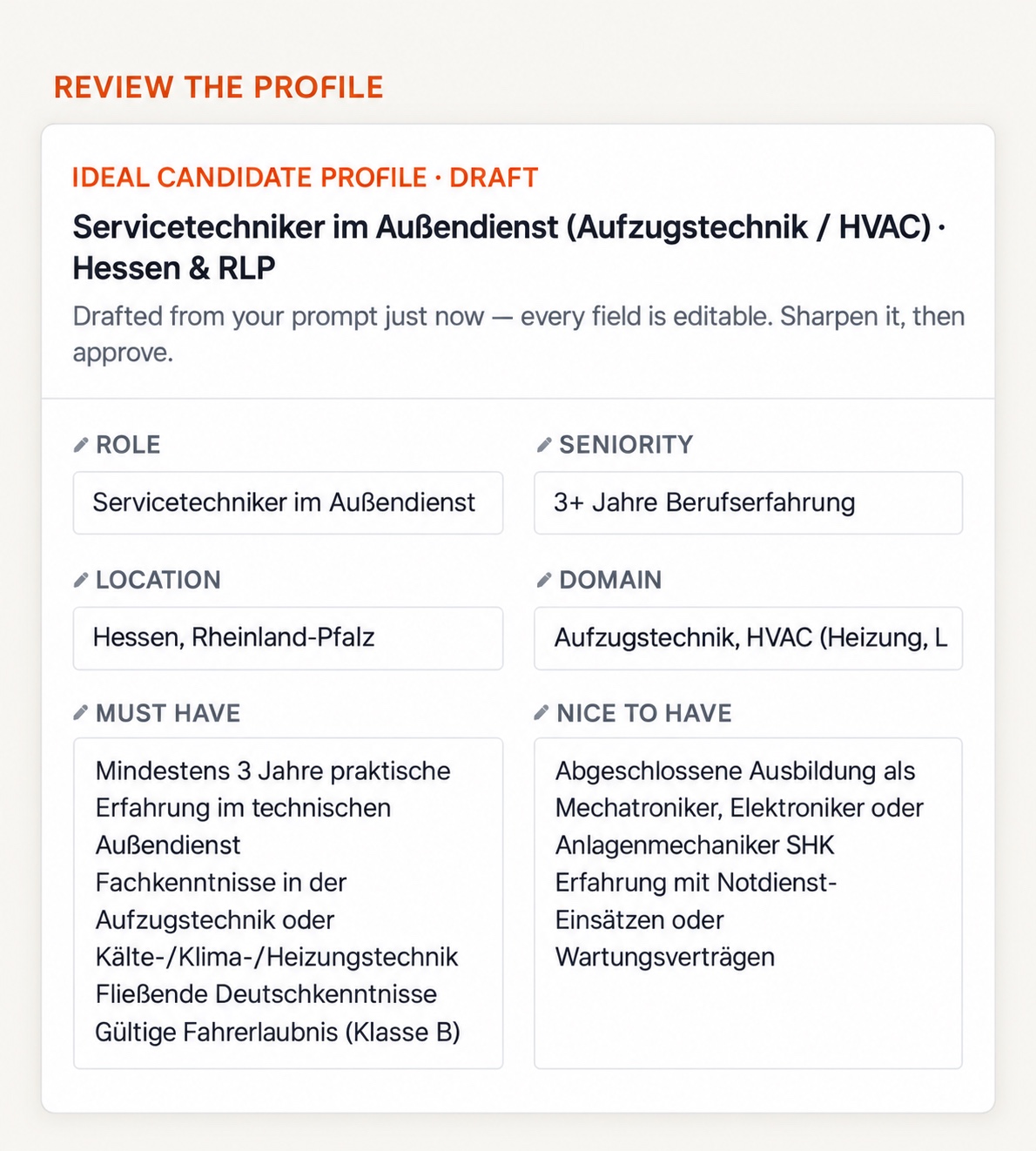
Prepare a sourcing brief for one open role
Use a synthetic role to set the scope, geography and criteria for a small recruiting search.
- Describe the role and location
- Separate required experience from preferences
- Set search terms before reviewing profiles