_edited_edited.png)
Sourcing in Recruiting A Modern Talent Playbook
- Janis Kolomenskis
- 4 hours ago
- 17 min read

Ever heard the term "sourcing" and wondered what it really means in the world of recruiting? Let's clear it up. Sourcing is the art and science of proactively hunting for qualified candidates for jobs you need to fill now—or in the future.
It’s a specialized role all about finding and engaging passive talent. These are the pros who aren't scrolling through job boards or updating their resumes. They're happily employed, doing great work, and would be a perfect fit for your team. Sourcing is the strategic mission to find them.
The Proactive Playbook for Modern Talent Sourcing

Welcome to the new age of talent acquisition! Gone are the days of posting a job and just waiting for the perfect person to apply. That old "post and pray" method is a recipe for disaster in today's cutthroat hiring market. To win, you need a proactive, strategic mindset that turns you from a recruiting coordinator into a genuine talent advisor.
Think about it this way: a reactive recruiter is like a fisherman who drops a single baited hook in the water and just hopes for a bite. But a proactive sourcer? They're more like a marine biologist who has already mapped the ocean floor, understands the currents, and knows exactly where the prize-winning fish are hiding. They use specialized gear to find them before anyone else even knows they're there. That's the heart of sourcing in recruiting—it's an exhilarating treasure hunt for the best people.
Why Sourcing Is Non-Negotiable Today
Let's be real: the modern job market is facing a massive skills gap, which makes proactive sourcing an absolute business necessity. This isn't just a hunch; the data backs it up. A recent ManpowerGroup study found that a staggering 76% of employers worldwide are struggling to fill open roles.
The problem isn't a lack of jobs; it's a critical shortage of available, qualified talent. You can get more eye-opening stats from SocialTalent's deep dive into the 2025 hiring reality check.
This talent scarcity means your dream candidates are almost never unemployed. They're the passive ones—currently killing it in their roles and not actively looking for a change. Sourcing is your only way to get on their radar.
The core mission of sourcing is to build relationships before a job even exists. It’s about creating a warm bench of pre-vetted, engaged talent that you can tap into the moment a need arises, dramatically reducing time-to-hire.
Shifting from Reactive to Proactive
Jumping into a sourcing-first approach requires a real change in how you think. It's about looking past the immediate fire drill of filling one open role and instead focusing on building a robust talent pipeline for the long haul. This guide is designed to give you both the mindset and the tools to make that switch.
Here’s what you gain with a proactive sourcing mindset:
Access to Top-Tier Talent: You get to connect with the top 15% of professionals who aren't looking for a job but are always open to an amazing opportunity.
Reduced Hiring Time: A well-nurtured pipeline means you have qualified, interested candidates ready to go the second a position opens up.
Improved Quality of Hire: Sourcing lets you be incredibly selective, pinpointing people who have the exact skills and experience your team needs.
Alright, let's get ready to build a winning talent pipeline from the ground up.
Mastering Your Core Sourcing Channels
Alright, let's get into the good stuff—building your sourcing toolkit! This is where the real hunt begins. Truly great sourcing isn't about casting the widest net possible and hoping for the best. It’s about knowing exactly which ponds to fish in and having the perfect lure for each one.
Think of these channels as different tools in your workshop. You wouldn't use a hammer to saw a piece of wood, right? In the same way, you can't just rely on LinkedIn to find a highly specialized open-source developer. Getting comfortable with each of these methods gives you the power to tackle any hiring challenge that lands on your desk.
The Art of Boolean Search
At its heart, Boolean search is the universal language of sourcing. It’s a deceptively simple—yet incredibly powerful—way to combine keywords with operators like AND, OR, and NOT to narrow your search results with surgical precision. You're essentially giving a search engine a very specific set of instructions, making sure it only brings back the profiles you actually want to see.
For instance, just typing "Software Engineer" into LinkedIn will drown you in millions of results. But a smartly written Boolean string can instantly cut through the noise.
AND: This is your focus tool. It narrows the search. means a profile must contain all these elements.
OR: This broadens your search to catch synonyms. A search for will find people with either of those titles.
NOT: This excludes terms you don't want. Searching for helps you filter out technical PMs if you need someone with a different background.
Parentheses (): Just like in math, these group your terms together. They let you build complex, layered queries to pinpoint exactly the right talent.
And the best part? This isn't just for LinkedIn. You can use these same principles on Google, inside your ATS, and across countless other databases. It’s the foundational skill every great sourcer needs.
Building Proactive Talent Pools
A talent pool is your secret weapon. Instead of frantically starting from scratch with every new job req, you're building and nurturing a curated database of pre-qualified, interested candidates. This is your "warm bench" of talent, ready and waiting for the perfect role to open up.
Think of it like being a general manager of a sports team. You aren't just drafting for today's game; you're scouting and building relationships with star players for the entire season. When a spot on the roster suddenly opens, you already know exactly who to call.
A talent pool transforms sourcing from a reactive, transactional task into a proactive, relationship-driven strategy. It’s the difference between constantly chasing leads and having a pipeline that works for you.
Get started by organizing your pools by role, key skills, or location. Keep notes on your conversations, their career goals, and what makes them a potential future star at your company.
Unlocking Social Sourcing Secrets
Social sourcing is all about meeting candidates where they live online. And no, this doesn't mean just blasting out a bunch of cold InMails. It's about authentically engaging in the communities where your ideal candidates hang out, share their expertise, and build their professional reputations.
So, where should you be looking?
LinkedIn: The obvious first stop, but the pros focus on engaging in relevant groups and leaving thoughtful comments on posts—not just cold outreach.
GitHub & Stack Overflow: Absolutely essential for finding top technical talent. See who is contributing to interesting projects or providing killer answers to tough questions.
Niche Communities: This is where the magic happens. Think specialized Slack channels, Discord servers, or industry-specific forums. This is where you'll find the truly passionate experts.
The key to winning at social sourcing is to give before you get. Share useful content, ask smart questions, and build a name for yourself as a helpful member of the community.
The Unmatched Power of Employee Referrals
Never, ever underestimate your most powerful sourcing channel: your own employees. Employee referral programs are a goldmine for high-quality, pre-vetted talent who often turn out to be a fantastic cultural fit. They come with a built-in stamp of approval from someone you already trust.
The data backs this up, big time. Budgets for employer branding have shot up by 107% in the last five years because companies see the payoff. Around 84% of companies now have referral programs for a simple reason: they work. Hiring through referrals can slash the time-to-hire by an incredible 55%. This isn't just a side project; it's a core pillar of a modern sourcing strategy. You can dive deeper into these hiring trends and statistics on TalentLMS.
To build a killer program, keep it simple, promote it often, and offer rewards that people actually want. When your employees become your best talent scouts, your sourcing power grows exponentially. To give your team even more firepower, check out our guide on the top 12 free resume search tools for recruiters.
With so many channels, it can be tough to know where to focus your energy. Here’s a quick breakdown of how they typically stack up against each other.
Sourcing Channel Effectiveness Comparison
While job boards might be low-effort, the most effective strategies—like referrals and nurturing talent pools—deliver higher-quality candidates much faster. A healthy mix is always best, but don't neglect the high-impact channels
Building a Repeatable Sourcing Workflow
Let’s be honest: Incredible sourcing isn't about random luck or frantic, late-night searching. It’s the direct result of building a systematic, repeatable engine. Moving from chaotic, one-off searches to a structured workflow is the single biggest leap you can make in your recruiting effectiveness. It’s about building a well-oiled machine that consistently delivers high-quality candidates, every single time.
This isn't just about saving your sanity (though it definitely helps with that!). A repeatable process ensures every search is thorough, every candidate has a great experience, and every hiring manager feels like a true partner in the process. This framework is what ties all the channels and techniques we've discussed into a cohesive, powerful strategy.
Step 1: Start with a Deep Discovery Phase
The entire sourcing process hinges on one thing: a crystal-clear understanding of who you're looking for. The discovery phase, or intake meeting, is your golden opportunity to go beyond the dry job description and truly get on the same page as your hiring manager. To really nail this, you have to master effective candidate profiling techniques.
Don't just ask about required skills. You have to dig deeper with powerful questions that get to the heart of the role:
Success Metrics: "What does a rockstar in this role actually accomplish in their first 90 days?"
Team Dynamics: "Who will they be working with most, and what kind of personality really clicks with this team?"
Must-Haves vs. Nice-to-Haves: "If you could only pick three essential skills, what would they be? What are we willing to teach?"
"Purple Squirrel" Profiles: "Can you show me a few LinkedIn profiles of people you think are amazing, even if we can't get them?"
This kind of collaborative approach instantly transforms the hiring manager from a client into a partner. You're both hunting for the exact same target from day one.
Step 2: Architect a Multi-Channel Strategy
With your ideal candidate profile locked in, it's time to map out where you'll find them. A huge mistake I see sourcers make is putting all their eggs in one basket (usually LinkedIn). A truly robust workflow diversifies the pipeline to protect you from market shifts and helps you find amazing talent hiding in plain sight.
This infographic lays out a simple but incredibly powerful four-step flow that hits the most effective sourcing channels.
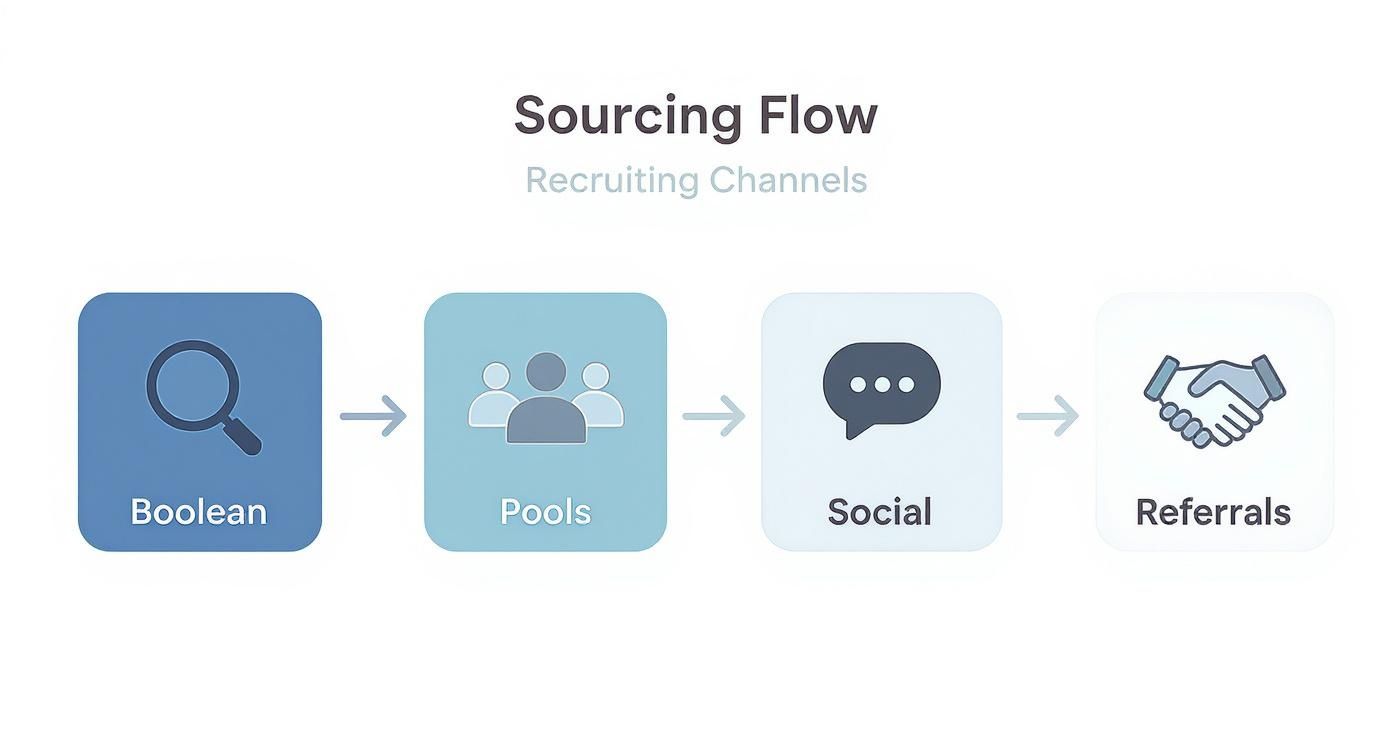
Think of it this way: you start broad and then progressively narrow your focus toward highly targeted, relationship-driven channels like referrals. That’s where the magic happens.
Step 3: Design Compelling Outreach Sequences
Finding the perfect profile is only half the battle. Now you have to write something that actually gets a response. The secret here is a mix of genuine personalization and persistence, which is best managed through a multi-step outreach sequence.
A solid sequence might look something like this:
Day 1 (LinkedIn): Kick things off with a personalized connection request and a short, high-impact InMail that references a specific project or skill of theirs.
Day 3 (Email): Follow up with a more detailed email. Give a nod to your initial LinkedIn message and provide more context about the role and why they came to mind.
Day 7 (LinkedIn): Gently re-engage by liking or commenting on one of their posts, or send a quick "bumping this up" message. Keep it light and respectful.
This multi-touch approach keeps you top-of-mind without being annoying, dramatically increasing your chances of getting noticed.
Step 4: Track Engagement and Manage Responses
As you start reaching out to more people, organization becomes your absolute best friend. A chaotic inbox is where great candidates go to die. This is where candidate relationship management becomes non-negotiable.
A great sourcing workflow isn't just about finding people; it's about remembering them. Meticulously tracking every interaction ensures you can nurture long-term relationships and build powerful talent pools for the future.
Use your Applicant Tracking System (ATS)—or even a well-organized spreadsheet—to log every single touchpoint. Note who's responded, who needs a follow-up, and which candidates might be a perfect fit for a role down the road. For a deeper dive, check out our complete playbook on candidate relationship management to improve your hiring. This systematic tracking is what turns your daily sourcing efforts into a valuable, long-term asset for the entire company.
Adapting Your Strategy for Hard-to-Fill Roles
Not all sourcing quests are created equal. Finding a senior software engineer requires a vastly different map than hunting for a Chief Financial Officer. Adapting your approach from a generalist to a specialist is what separates good sourcers from the truly great ones who can conquer any challenge.
For these tough-to-fill roles, your standard playbook just won't cut it. You have to go deeper, get more creative, and operate with a level of precision that high-demand candidates expect. It’s time to elevate your game for the recruiting big leagues.
Sourcing for Highly Technical Talent
When you're recruiting technical talent, LinkedIn is often just the starting point, not the finish line. The world’s best developers, data scientists, and engineers live and breathe code on platforms where their work speaks for itself. And that's exactly where you need to meet them.
To find elite technical talent, you've got to think like a developer. This means shifting your focus to the places where credibility is earned through contribution, not just a slick profile.
Here’s where you’ll find them:
GitHub: Think of this as the ultimate developer portfolio. Don’t just glance at profiles; dive into their repositories. Are they contributing to interesting open-source projects? Is their code clean and well-documented? This gives you incredible, firsthand insight into their actual skills.
Stack Overflow: This Q&A site is an absolute goldmine. Look for users who consistently provide high-quality, insightful answers to complex technical problems. Their reputation score is a powerful indicator of expertise and a willingness to help others—a fantastic sign of a team player.
Niche Communities: Get involved in specialized Slack channels, Discord servers, and forums dedicated to specific programming languages (like Python or Rust) or technologies (like machine learning). Participating authentically in these communities builds trust and uncovers talent nobody else can find.
The Art of Executive Search Sourcing
Sourcing for executive leadership is a completely different ballgame. It's less about volume and all about surgical precision, long-term relationship building, and absolute discretion. These candidates are rarely looking, and they're often wary of recruiters. Your outreach has to be flawless.
When sourcing for executive roles, you are not just filling a position; you are shaping the future of the company. Your approach must reflect the gravity of that responsibility, focusing on trust, confidentiality, and deep industry knowledge.
Success in executive search really hinges on a few key principles. You need to plug into elite professional networks and show you understand what truly motivates a leader to even consider a move. The best first move? A warm introduction from a trusted mutual connection.
Tapping into Global Talent Pools
When local talent shortages create what feels like an impossible hiring scenario, looking beyond your borders is a powerful solution. International sourcing opens up a vast, untapped pool of exceptional talent, letting you find the exact skills you need, no matter where they are.
This isn't some niche strategy anymore; it's a global standard for competitive companies. In fact, recent data shows that 71% of recruiting teams have engaged in international hiring. And get this—an impressive 87% of employers successfully filled at least 40% of their open roles with talent from outside their local area. This trend is especially strong in tech, where 89% of employers actively pursue global candidates. You can explore more fascinating data about global recruiting trends on SelectSoftware Reviews.
Building a global talent pipeline gives you a massive competitive advantage. It allows you to overcome local skill gaps, boost diversity, and bring fresh perspectives into your organization, driving innovation on a whole new scale.
Using AI and Relationship Intelligence to Find Talent Faster

It's time to give your sourcing a serious upgrade. While basic automation is helpful, the real game-changer is combining Artificial Intelligence (AI) with relationship intelligence. This is where sourcing stops being about just finding profiles and starts being about uncovering the hidden human connections that actually lead to hires.
Picture this: you've just found the perfect candidate on LinkedIn. Their experience is a flawless match, and you just know they'd be a star on your team. But instead of sending another cold InMail that will likely get ignored, what if you could instantly see that your CEO used to work with them?
That's the magic of relationship intelligence.
What Is Relationship Intelligence?
Think of relationship intelligence as putting on a pair of x-ray glasses for your company's entire network. It’s a type of software that automatically maps and understands the professional connections of everyone in your organization—from the execs to the engineers—to show you exactly who knows whom.
It works by pulling data from places like email, calendars, and professional networks to build a single, searchable map of every relationship. Suddenly, your entire company’s network becomes a warm sourcing channel, letting you find introduction paths you never knew existed. To really get a handle on this, check out our complete guide to relationship intelligence platforms.
This completely flips the script on traditional sourcing. Instead of starting cold and fighting for attention, you start with a warm introduction from a trusted colleague. This simple shift can boost your response rates from a dismal 2% all the way up to 67% or even higher. It’s a total game-changer.
From Cold Outreach to Warm Introductions
Let's walk through how this actually works in the real world. This is how you stop sourcing cold and start sourcing smart by using technology to find the warm path in.
Identify a Target Candidate: You find an amazing Senior Product Manager on LinkedIn. She’s got the perfect blend of SaaS experience and startup grit—a classic needle-in-a-haystack profile.
Uncover the Hidden Connection: Before hitting that "Connect" button, you run her profile through a relationship intelligence tool like Yena. Instantly, the platform reveals that your Head of Engineering, Sarah, is a first-degree connection who worked with this candidate at a previous company.
Leverage the Warm Path: The tool even shows you they collaborated on several projects. Bingo! You now have everything you need. You send a quick Slack message to Sarah, who is happy to make a warm introduction.
This is the very essence of modern sourcing in recruiting. It’s about using smart tools to amplify the power of human connection, not replace it. You can learn more about the role of Artificial Intelligence in talent acquisition and see how much it's shaking up the industry.
By mapping your organization’s collective network, you transform every employee into a potential super-connector. This unlocks thousands of warm introduction paths to top-tier talent that would otherwise remain completely invisible.
The Immediate Impact on Sourcing
Plugging this kind of intelligence into your workflow has a massive and immediate impact on your sourcing metrics. We're not just talking about getting a few more replies; we're talking about fundamentally changing the efficiency and quality of your entire hiring funnel. This is especially true for those tough-to-fill senior and specialized roles where a cold message just won’t cut it.
So, what really changes?
Drastically Higher Response Rates: Let's be real—a warm intro from a trusted colleague is always going to get more attention than a cold message from a recruiter.
Faster Time-to-Hire: You get to skip the awkward "who are you?" phase and jump straight into meaningful conversations with candidates who are already interested and pre-vetted.
Improved Candidate Quality: The best people almost always know other great people. Tapping into your internal network is a natural way to surface incredible, high-caliber talent.
Stronger Hiring Manager Partnerships: When you can go to your hiring manager and show them a warm lead you found through one of their own connections, you instantly build credibility and a rock-solid partnership.
Measuring the Impact of Your Sourcing Efforts
Sourcing can feel like a creative art, but proving its value is all about the science. How do you actually show that all your hard work is paying off? It all comes down to tracking the right Key Performance Indicators (KPIs).
These aren't just numbers to make you look busy. They're the vital signs that connect your sourcing activities directly to the company's bottom line. Tracking KPIs lets you fine-tune your approach, celebrate your wins, and have way more productive conversations with hiring managers. It’s how you go from saying, "I found some great people," to, "My outreach strategy cut our hiring time by 20%." Now that's a language every leader speaks.
Core Sourcing KPIs You Must Track
To really get the full story of your performance, you need to look at a mix of metrics covering speed, quality, and efficiency. Each one reveals a different piece of the puzzle.
Source of Hire: This is your ground zero. It tells you precisely where your best hires are coming from—employee referrals, your Boolean search on LinkedIn, a deep dive on GitHub, you name it. Knowing this helps you pour your energy into the channels that deliver and stop wasting time on the ones that don’t.
Time to Fill: This one’s a classic for a reason. Calculated from the moment a job req opens until the offer is signed, this KPI is a direct measure of your team's speed. A consistently short Time to Fill proves that your proactive sourcing is building a pipeline of warm talent, ready to go when you need them.
Candidate Response Rate: So simple, yet so telling. What percentage of people are actually replying to your messages? A high response rate—and for highly targeted outreach, you should be aiming for 30% or higher—is a clear sign that your messaging is on point, personal, and reaching the right people.
The Ultimate Metric: Quality of Hire
While speed is great, nothing beats bringing in genuinely fantastic people who stick around and make a real impact. Quality of Hire is the true north star of sourcing success, even if it's a bit tougher to nail down with a single number. It’s a blend of a few different data points that gives you a much clearer picture.
Quality of Hire is the bridge between your sourcing activity and actual business outcomes. It answers the most important question: Are the candidates you found just filling a seat, or are they driving the company forward?
You typically measure this by combining a few inputs, usually gathered about 6 to 12 months after someone starts:
Hiring Manager Satisfaction: How happy is the manager with their new team member? A quick survey can capture this perfectly.
Performance Review Scores: How did the new hire stack up in their first official performance cycle?
Retention Rate: A simple but powerful one—did they stay with the company for at least a year?
By keeping a close eye on these KPIs, you create a powerful feedback loop. You can draw a straight line from your sourcing strategies to real business results, proving your value in a way that's impossible to ignore. For a more exhaustive list, explore our deep dive into the essential recruiting metrics you need to improve hiring.
Common Questions About Sourcing in Recruiting
Let's dive into some of the questions that pop up all the time when people talk about talent sourcing. It can feel like a complex world at first, but once you get the hang of a few key concepts, you'll be sourcing like a pro in no time. We'll break down the common sticking points into simple, straightforward advice.
What Is the Main Difference Between Sourcing and Recruiting?
Think of it this way: sourcing is the "hunting," and recruiting is the "gathering."
Sourcing is all about the proactive search—it’s the art of finding and engaging fantastic candidates for a role. This usually means tracking down passive talent, those rockstars who are great at their jobs but aren't actively scrolling through job boards. Sourcing is what kicks off the conversation and gets the ball rolling.
Recruiting, on the other hand, is the bigger picture. It's the full journey that actually starts with sourcing. Once a sourcer finds and warms up a great candidate, the recruiter steps in to manage the rest: screening, interviewing, making the offer, and finally, bringing that person onto the team.
So, in a nutshell: sourcing finds the talent, and recruiting brings them home.
What Are the Most Essential Tools for a Sourcing Beginner?
When you're just starting out, it's easy to get distracted by all the fancy tools out there. My advice? Don't. Focus on mastering just three essentials, because depth beats breadth every single time. These are the absolute bedrock of any killer sourcing strategy.
Your must-have toolkit includes:
LinkedIn Recruiter (or Sales Navigator): This one’s non-negotiable. It's the biggest professional playground on the planet, and its filters are your best friend.
Boolean Search Operators: Getting really, really good with operators like AND, OR, NOT, and parentheses will turn you into a search wizard on Google, LinkedIn, and pretty much any database you touch.
A Simple Tracking System: It doesn't have to be complicated! Whether you're using a full-blown Applicant Tracking System (ATS) or just a super-organized spreadsheet, you need one central spot to manage your pipeline, keep track of who you've talked to, and jot down notes.
Once you’ve got these down cold, then you can start exploring everything else.
The best sourcers don't have the most tools; they have the deepest command of the essential ones. Your ability to write a perfect Boolean string is worth more than a dozen subscriptions to niche platforms.
How Can I Start Building a Talent Pool with No Budget?
You can absolutely build a phenomenal talent pool without spending a dime. It just takes a bit more hustle, creativity, and a focus on building real connections.
Start by being intentional about growing your personal LinkedIn network with people in your target roles and industries. Don't just send random requests—find relevant online groups, niche Slack communities, and industry forums where your ideal candidates hang out and actually participate in the conversation. As you find promising people, track them meticulously in a simple spreadsheet.
And here's the big one: build an amazing referral culture at your own company. Make it easy, make it fun, and make sure people feel recognized for sending great talent your way. Employee referrals are a free, powerful engine for building a pipeline of high-quality, pre-vetted candidates.
Ready to stop sourcing cold and start uncovering the warm introduction paths hidden in your network? Yena uses AI-powered relationship intelligence to instantly map who at your company knows your dream candidate. See how it works and get your response rates up to 67%.
Comments