_edited_edited.png)
Boolean Search vs Natural Language Recruiting: Which Is Better?
- Janis Kolomenskis
- Oct 8
- 10 min read

When it comes to Boolean search vs natural language recruiting, I don't see it as a competition. It’s a powerful partnership. Boolean search offers handcrafted precision with its logical operators, while natural language sourcing brings AI into the mix to understand context and intent, completely changing the game in talent discovery.
Honestly, the best strategy is learning how to blend the strengths of both.
The New Era of Talent Sourcing
Welcome to the future of finding top talent! The recruitment world, particularly for sharp professionals here in the DACH/CEE region, is undergoing a massive shift. To get an edge, we need to move beyond the old-school methods and embrace smarter, faster ways of connecting with candidates.
This means knowing exactly when to pull out the surgical precision of a well-crafted Boolean string and when to let an intuitive, AI-driven conversational search do the heavy lifting.
As sourcing gets more sophisticated, concepts like workflow automation are becoming absolutely essential for building modern, efficient strategies. It's about so much more than just finding profiles; it’s about creating a smooth process that marries the best of human logic with machine intelligence. The real goal here is to spend less time buried in admin and more time actually building the relationships that lead to great placements.
If you're curious about the tech making this happen, have a look at our guide on the top AI recruiting tools for 2025.

Quick Glance Comparison
To get a feel for how these two approaches stack up, here’s a quick look at their core differences.
Attribute | Boolean Search | Natural Language Recruiting |
|---|---|---|
User Input | Requires specific operators (AND, OR, NOT) | Accepts conversational phrases and sentences |
Learning Curve | Steeper; requires training to master syntax | Minimal; highly intuitive and user-friendly |
Flexibility | Rigid and literal; finds exact keyword matches | High; understands synonyms, context, and intent |
Best For | Highly specific, niche roles with fixed criteria | Broad talent mapping and discovering hidden talent |
As you can see, they each have their own sweet spot. One gives you ultimate control, while the other offers incredible speed and a wider net.
Defining the Core Sourcing Methods

Before we can pit these two giants against each other, we need to get to grips with what they really are. If you want a solid foundation, it’s worth exploring the fundamental concept of sourcing in HR to see how these techniques fit into the bigger picture of talent acquisition.
Ready? Let’s dive into the two powerhouse methods at the heart of modern recruiting.
The Logic of Boolean Search
Boolean search is the recruiter's old faithful. It’s a manual, logic-based approach where you are the pilot, giving a database a set of very specific, non-negotiable commands. You're in total control, using what we call operators to build the perfect search string.
It all boils down to three simple commands:
AND: This is for narrowing your search. You need every single keyword present, like "Softwareentwickler" AND "Java" AND "München". No exceptions.
OR: This broadens your horizons, allowing for alternatives. Think "Projektmanager" OR "Project Manager" to catch both German and English titles.
NOT: Your filter for cutting out the noise. For instance, "Java" NOT "Script" ensures you don’t get a flood of frontend developers when you need a backend specialist.
This method is all about precision—building a search query like a detailed blueprint. You get exactly what you ask for, and its real strength lies in surgically removing irrelevant profiles from your results. For those looking to add a bit more firepower, some of the top LinkedIn sourcing Chrome extensions can help put parts of this process on autopilot.
The Intuition of Natural Language Recruiting
Now, natural language recruiting completely flips the script. This is where Artificial Intelligence (AI) and Natural Language Processing (NLP) come into play, creating a system that understands human language—context, intent, and all. Instead of barking rigid commands, you just talk to it.
You’re not just typing keywords; you’re describing your ideal candidate as if you were talking to a colleague. This lets the system figure out synonyms, related skills, and even infer what you mean.
Let’s say you type, "Show me software developers in Berlin with Java skills who have worked in FinTech." The AI is smart enough to know that 'Softwareentwickler' is the German equivalent. It understands that 'FinTech' means experience with financial technology, and it will probably even look for related skills like Spring Boot or SQL that often go hand-in-hand with Java.
It's a much more intuitive way to cast a wider, yet surprisingly relevant, net.
Let's Compare These Sourcing Powerhouses
Alright, it's time for a head-to-head comparison. To really get a feel for the difference between Boolean search and natural language recruiting, we need to go beyond the textbook definitions and see how they stack up in the real world of recruiting. This isn't just about syntax; it's about the real impact each method has on your sourcing results.
We’re going to compare them on the things that actually matter to us recruiters in the DACH and CEE regions: precision, efficiency, the skills you need to use them, and how well they adapt to different situations.
Precision vs. Contextual Understanding
When it comes to precision, Boolean search is still the king. If you absolutely need a candidate with a non-negotiable certification or a very specific tech stack, a perfectly crafted string like is your best friend. It’s like a laser beam, cutting through all the noise to give you exactly who you asked for.
But natural language recruiting is all about context. It’s brilliant at figuring out what you actually mean and understanding how different skills relate to each other. A search like, "experienced marketing manager in Hamburg who understands SEO and content strategy for B2B tech" lets the AI find people with titles like "Head of Content" or "Digital Marketing Lead" who have the right skills, even if their profiles don't contain those exact keywords.
Think of it this way: Boolean gives you literal matches, putting you in the driver's seat. Natural language gives you relevant matches by understanding your intent, which can uncover hidden talent pools you would have completely missed.
Learning Curve and Skill Requirements
Let's be honest, the skill barrier for Boolean is pretty high. Getting good at it means mastering logical operators, nesting parentheses, and using all the advanced modifiers. It’s a real craft that takes time and practice to get right, and one wrong quotation mark can throw your entire search off course.
On the other hand, natural language search is designed to be intuitive. If you can describe your ideal candidate to a colleague over coffee, you can use a natural language tool. This makes it incredibly easy to get started, letting even junior recruiters source effectively from day one. For growing teams, that accessibility is a total game-changer.
This infographic really nails the core differences when it comes to complexity, speed, and accuracy.
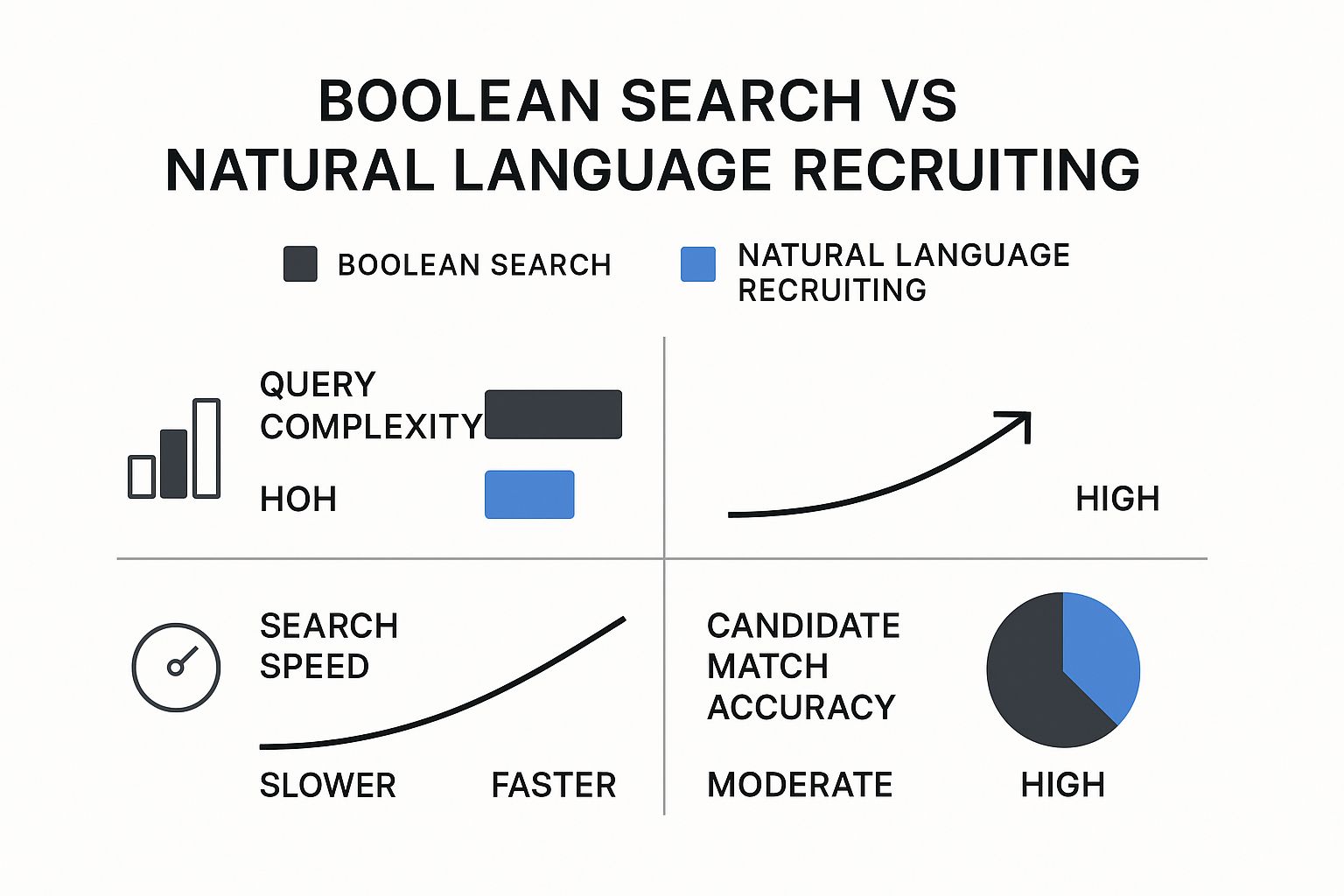
As you can see, Boolean requires more upfront effort to build the query, whereas natural language speeds things up and often finds more accurate matches by understanding the bigger picture.
Speed and Sourcing Efficiency
When we're talking about pure speed, natural language recruiting pulls way ahead. In Germany’s fast-paced recruiting scene, where Boolean has been the gold standard for ages, recruiters spend a ton of time building and tweaking their search strings. In fact, recruiters report spending 40% more time on sourcing tasks with manual Boolean compared to AI-powered tools. That's huge!
Some studies show that AI-enhanced sourcing in Germany can be up to 10 times faster, which means you can connect with candidates that much quicker. You can get more details on this from hireEZ's research on AI sourcing.
This incredible speed lets you build much broader and more robust talent pipelines in a fraction of the time. For a deeper dive into some of the best tools out there, check out our guide on the top 12 free resume search tools for recruiters in 2025.
Choosing Your Tool for the Job
Top-tier recruiters know the debate isn't really "Boolean vs. Natural Language." It’s about knowing which tool to pull out of your toolkit at any given moment. The real skill lies in deciding when you need a scalpel and when you need a smart, wide-reaching net. This is what truly separates the good from the great.
That ability to pivot is especially vital for sourcers in the fast-moving DACH and CEE markets, where job specs can get incredibly precise.
When Boolean Search Is Your Champion
Think of Boolean as your high-precision instrument. It's built for those searches where the criteria are black-and-white, totally rigid, and non-negotiable. It absolutely sings when you need complete control and can't afford any ambiguity in your results.
You'll want to lean on Boolean for scenarios like these:
Highly Specific Tech Stacks: You're hunting for a "DevOps Engineer" who must have "Kubernetes" AND "Terraform" but explicitly NOT "Ansible".
Mandatory Certifications: The mission is to find a "Project Manager" in Frankfurt who holds a "PMP" certification. It's a simple yes or no—they either have it, or they don't.
Niche or Regulated Roles: You need to find a "Financial Controller" with direct experience in "IFRS 17" for an insurance client in Zürich.
In situations like these, the exact keywords are everything. You aren't exploring related skills; you're looking for an exact match, and Boolean's logical operators give you precisely that. No fluff, just facts.
When Natural Language Recruiting Is Your MVP
Natural language recruiting, with AI as its engine, is your most valuable player when you need to grasp context, find those hidden gem candidates, and build a strong pipeline without spending all day on it. It’s your go-to for broader, more exploratory searches where the intent behind the search is more important than the exact keywords.
Natural language is the clear winner when you're:
Building High-Volume Pipelines: A search for "customer support agents in Poland who are fluent in German" will instantly generate a huge, qualified pool of people to talk to.
Exploring Adjacent Skill Sets: A client wants a "Growth Hacker." A natural language search is smart enough to find fantastic candidates with titles like "Digital Marketing Specialist" or "User Acquisition Manager" who have the exact skills needed.
Sourcing for Vague or Varied Titles: A query like "experienced software engineer in AI" can unearth candidates with titles ranging from 'Data Scientist' to 'Machine Learning Specialist'. It works by mapping synonyms and actually understanding the context—a massive advantage in Germany’s nuanced labour market where Boolean would miss out. You can find more on these semantic search capabilities on Mediatum.
This smarter approach lets you move faster and with more confidence, especially when it's built into your main workflow. To really see this in action, check out how you can boost hiring efficiency with an AI-native ATS.
Unlocking a Hybrid Sourcing Strategy
So, why force yourself to choose between Boolean search and natural language recruiting? The smartest recruiters I know aren't picking sides. They're blending the two into a powerful, integrated sourcing strategy that delivers both incredible speed and laser-focused accuracy.
This hybrid approach is where the real magic happens. It’s not about one method being better than the other; it’s about using them as partners in a seamless, two-step workflow. You’re essentially merging the broad discovery power of AI with the surgical precision of classic logic.
A Powerful Hybrid Workflow
Picture this: you kick off a search with a simple, conversational query. You let a natural language tool do the heavy lifting, quickly mapping the talent landscape and pulling together a large, highly relevant talent pool. This is your speed-and-scale phase, casting a wide but intelligent net.
Then, you switch gears. With that initial talent pool in hand, you dive in with precise Boolean operators to filter and refine. This is your precision phase. You’re no longer searching the entire database, but surgically narrowing down your AI-generated list to find those perfect-fit candidates.
This hybrid model lets you:
Start Broad and Fast: Use natural language to quickly get a feel for the talent out there and build a strong initial candidate list.
Refine with Precision: Apply specific Boolean strings to that list to zero in on non-negotiable skills, specific industry experience, or other must-haves.
Maximise Your Results: You ensure no hidden gems are overlooked in the initial search, while still maintaining absolute control over your final shortlist.
By combining these methods, you're not just finding candidates; you're engineering a smarter sourcing process. You get the contextual understanding of AI to build the pipeline and the logical control of Boolean to finalise it.
Honestly, this approach gives you a massive competitive edge. It’s all about engaging the best people faster and more effectively than your competition. It's the ultimate combination of human expertise and machine intelligence, built for the realities of modern recruiting.
Your Sourcing Questions Answered

When it comes to Boolean search vs natural language recruiting, a few questions pop up time and time again. Let's get them answered so you can feel confident using both approaches to your advantage.
Is Boolean Search Becoming Obsolete?
Not a chance! While AI-powered natural language search is a game-changer, Boolean is still the sharpest tool in the box for certain jobs. It’s absolutely essential for those high-precision, needle-in-a-haystack searches.
Think about it: when you must find a candidate with a rare, non-negotiable certification or a very specific tech stack, a well-built Boolean string delivers surgical accuracy that nothing else can match.
How Can I Start Using Natural Language Search?
The easiest on-ramp is to dive into an AI-native recruiting platform. Many of the newer Applicant Tracking Systems (ATS) and sourcing tools are built from the ground up with natural language search at their core.
These systems are designed to be incredibly intuitive. You can literally just type what you’re looking for in plain German or English, and the AI does the heavy lifting.
Give it a go with a simple query describing your ideal hire. Something like, "senior java developer in Berlin with fintech experience," is a perfect starting point. You’ll be amazed at how the platform interprets your request and instantly expands the search for you.
Which Method Is Better for Candidate Diversity?
This is where natural language recruiting really shines. It gives you a massive advantage in building a more diverse talent pool.
It helps strip away unconscious bias by focusing on a candidate’s actual skills and experience, rather than just the specific keywords you think you should be looking for. By understanding context and synonyms, it uncovers fantastic profiles from all sorts of backgrounds that a rigid Boolean string would likely miss completely.
Ready to merge the power of AI with your recruiting expertise? Yena is the all-in-one hiring OS designed for the DACH market, combining intuitive natural language search with powerful automation to help you make more placements, faster. Discover how Yena can transform your workflow.
Comments