_edited_edited.png)
Find People in Your Networks Using AI The Smart Way
- Janis Kolomenskis
- Oct 18
- 12 min read

Remember those days of endlessly scrolling through LinkedIn, digging through ancient emails, and flicking through your phone's contact list just to find one person? It was a nightmare. That whole frustrating ritual is officially a thing of the past.
Now, to find people in your networks using AI, you can use smart tools that pull all your scattered contacts into one place. This lets you ask a simple question like, 'who do I know that works in renewable energy in Berlin?' and get an instant, spot-on answer.
Beyond Manual Searches: The AI Networking Revolution

Let's be honest, the days of painstakingly manual networking are on their way out. We're in the middle of a massive shift, moving away from basic keyword searches and into a world where technology actually understands the context and strength of our professional relationships. This isn't some far-off sci-fi concept; it's here, and you can start using it right now.
The Problem with Fragmented Networks
Your network is probably your single greatest professional asset, but chances are it’s a chaotic jumble spread all over the place. Just think about where your contacts live:
LinkedIn connections: You might have thousands, but how many do you genuinely know?
Email archives: A treasure trove of real interactions, buried under years of messages.
Phone contacts: Just a simple list of names and numbers, completely stripped of vital context.
Old spreadsheets: Those forgotten lists from past projects and events, gathering digital dust.
This fragmentation makes it impossible to see the whole picture. You can't effectively find people in your networks using AI if the AI can't see your entire network. The real magic happens when you bring all that scattered data together to create a single, intelligent engine.
A Smarter Way to Connect
Imagine a system that doesn't just hold names but actually grasps relationships. Instead of just searching for "John Schmidt," what if you could ask your network a complex question in plain English? This is a huge jump from the rigid constraints of traditional Boolean logic, opening the door for much more intuitive and powerful discovery. For a deep dive on this, check out our guide on Boolean search vs natural language.
This new way of thinking is part of a much bigger movement. In Germany, for instance, the use of AI for gathering information is exploding. By 2025, the spike in AI-driven searches will signal a fundamental change in how we find what we need. With over half of Germans already using generative AI tools regularly, it's clear that AI is becoming deeply woven into our professional lives. This makes it the perfect moment to bring these methods into your networking.
The goal isn't just to find a name on a list. It’s about uncovering the warmest, most effective path to the person you need to reach, all with the crucial context of how you’re connected.
By putting AI to work, you turn your static contact list into a dynamic, living asset. It helps you find exactly who you need, precisely when you need them. Say goodbye to cold outreach for good.
Build Your Own Personal Relationship Engine
Let's be honest, your professional network is probably a total mess. It's your most valuable asset, yet it's scattered everywhere—contacts in Gmail, connections on LinkedIn, numbers on your phone, and who knows how many names are buried in old spreadsheets. This chaos makes it impossible to see the full picture, let alone find the right person when you need them.
It's time to fix that. The very first move is to pull all those disconnected sources together into one powerful, unified system. This isn't just about getting organised; it's about building the solid foundation that lets AI really work its magic for you.
From Chaos to Cohesion
Your mission is to create a 'single source of truth' for every single professional relationship you have. This means exporting your contacts from each platform and bringing them all into one central hub. The good news? Modern AI tools are built to do all the heavy lifting.
They handle the tedious tasks that would take you weeks to do by hand:
Ditching duplicates by cleverly merging multiple entries for the same person.
Stitching profiles together from different platforms into one complete record.
Powering up your data by automatically finding the latest job titles and company info.
Suddenly, everything is connected and clean. That contact you emailed back in 2018 is now linked to their current senior role you saw on LinkedIn last week. You finally have the complete picture.
Building this unified network is the single most important thing you can do. Trying to use AI for networking without a central, enriched database is like trying to navigate a city with a dozen torn map fragments—you’ll just go in circles.
Keeping Your Engine Finely Tuned
Once your relationship engine is up and running, you've got to keep it in good shape. An out-of-date network will only give you out-of-date results. The most common mistake is letting your contacts go stale. Imagine a key contact moves from a startup in Munich to a huge corporation in Hamburg—if your system doesn't know that, your next intro request is dead on arrival.
To stop this from happening, just set aside a little time for network maintenance. The best AI platforms will automate most of this, but a quick human check guarantees everything is spot-on. This is a core part of what we call talent relationship management, a topic we dive deep into in our guide on mastering talent relationship management. Think of it as nurturing your network like the living, breathing asset it is.
Try this simple weekly routine:
Check out new connections the AI suggests.
Quickly verify automated profile updates for your most important contacts.
Merge any stragglers or duplicates the system might have missed.
Just 15-20 minutes a week is all it takes to keep your personal relationship engine performing at its peak. This tiny investment pays off massively, turning your static contact list into a dynamic intelligence system that’s always bubbling up with new opportunities and pathways for those crucial warm introductions.
Talk to Your Network with Semantic Search
Alright, this is where the real magic begins. Forget the old-school way of frantically searching your contacts, trying to recall exact names or job titles. That whole process is now a relic. We're moving beyond just digging for data and into having a real, intelligent conversation with your network.
Imagine being able to just ask, "Who did I meet at that tech conference in Hamburg last year who works in fintech?" Or, even better, "What's my strongest path to get an introduction to someone at Siemens?" This isn't science fiction anymore. This is precisely what you can do when you find people in your networks using AI powered by semantic search.
Think Concepts, Not Just Keywords
Let’s be honest, traditional keyword search is painfully literal. If you don't type in the exact word or phrase, you get nothing. It's a dead end. Semantic search, on the other hand, is a complete game-changer because it gets what you mean, not just what you type.
It dives deeper, understanding the context and intent behind your questions. This is all made possible by incredible leaps in Natural Language Processing (NLP), which is how computers learn to understand human language, nuance, and all. The result? You can ask your network questions using everyday language and abstract ideas, turning your static list of contacts into a living, breathing database you can talk to.
This infographic gives you a great visual of how it all works—taking your natural language question and pulling out the most relevant people from your entire network.
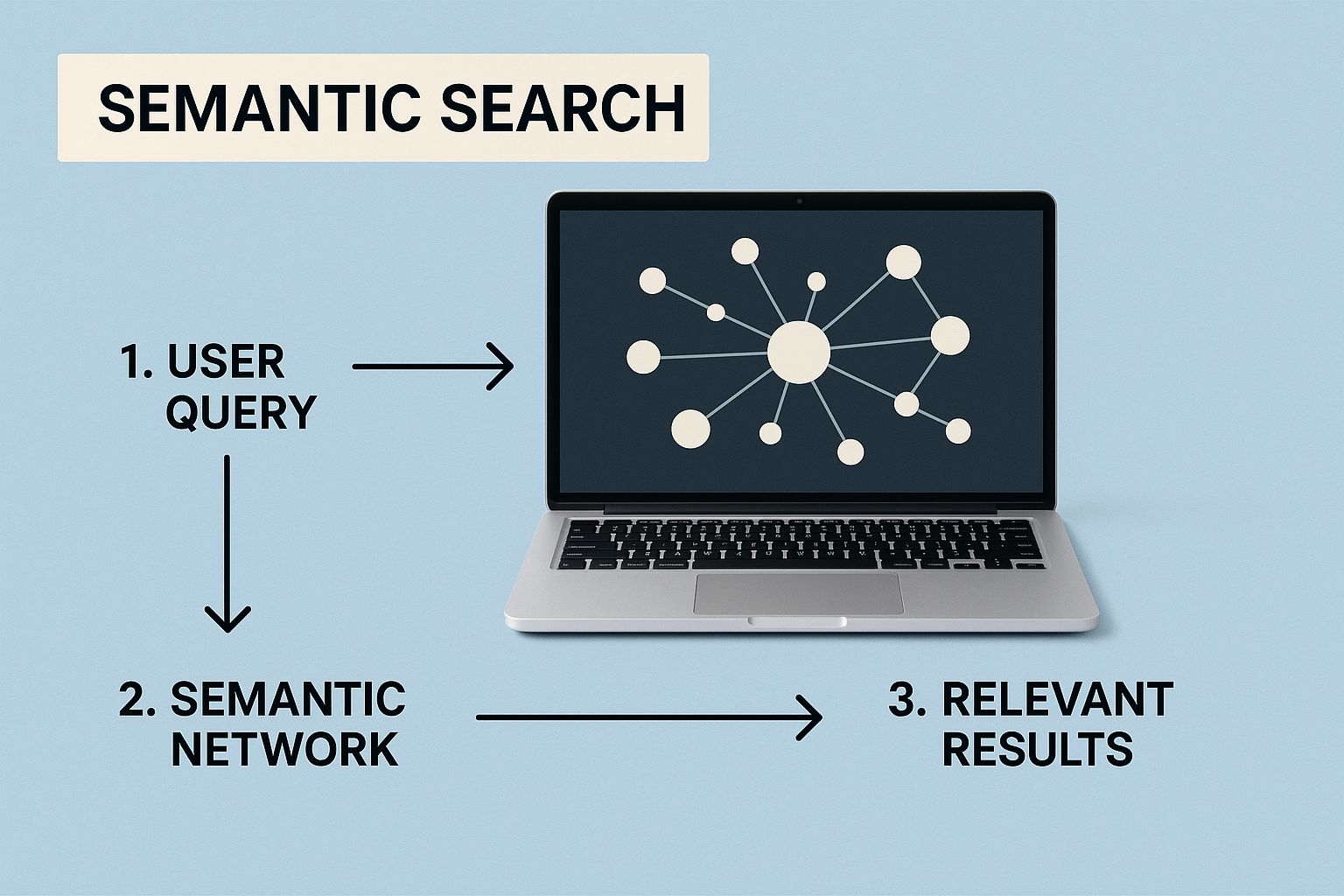
The big idea here is that semantic search connects your abstract thoughts to actual people by spotting the relationships hiding in plain sight within your data.
Before we dive into some powerful query examples, let's quickly break down just how different these two approaches are.
Traditional vs AI-Powered Network Search
This table puts the old, clunky methods side-by-side with the smart, intuitive capabilities of an AI-powered semantic search.
Feature | Traditional Keyword Search | AI-Powered Semantic Search |
|---|---|---|
Search Logic | Finds exact word matches only. | Understands context, synonyms, and intent. |
Query Type | "John Schmidt" or "Marketing Manager" | "Who do I know in marketing in Berlin?" |
Data Sources | Searches limited fields (name, title, company). | Analyses emails, calendars, notes, and messages. |
Relationship Insight | Shows a connection exists but not the quality. | Reveals the strength and context of relationships. |
Discovery | You have to know what you're looking for. | Uncovers connections you didn't know you had. |
As you can see, it's not just an upgrade; it's a completely different, and far more powerful, way to approach your network.
Powerful Queries That Uncover Hidden Gems
Let's get practical. Instead of wrestling with filters and basic search bars, you can now ask some seriously powerful questions that surface connections you'd long forgotten.
Here are a few ideas to get your wheels turning:
Go by Experience: "Find contacts I've emailed about machine learning projects in the past."
Focus on Relationships: "Who in my network knows someone at Bosch and has worked with them before?"
Search by Skills: "Show me software developers who are experts in Python, based on our past conversations."
These aren't just fancy searches. The AI is actually analysing the content of your past emails, calendar invites, and mutual connections to find the most relevant people. This is a massive advantage for recruiters and sales teams trying to match complex needs with the right talent or leads. To see this in action for hiring, check out our guide on how to supercharge your hiring with AI candidate matching for your ATS.
With semantic search, you stop being a simple user searching a database. You become a detective, and the AI is your intelligent partner, helping you piece together clues from your entire professional life to find the exact person you need, right when you need them.
This change is fundamental. You're finally able to tap into the collective memory of your network, bringing forgotten relationships and hidden opportunities back to the surface. It’s all about working with the true depth of your connections, not just the names on a list.
Charting Your Course to a Warm Introduction
So, you’ve found the perfect person to connect with. Fantastic! But that’s really only half the journey. The real magic happens when you get a warm introduction, and this is where AI completely changes the game from a shot in the dark to a strategic play.
Gone are the days of staring at a LinkedIn profile, scrolling through mutual connections, and guessing who might be the best person to ask for an introduction. AI takes all that guesswork off your plate. It dives deep into your newly unified network, crunches thousands of data points, and literally maps out the most solid, credible paths to your target.
Seeing Your Strongest Connections in a New Light
How exactly does it pull this off? An AI-powered relationship engine does more than just spot a mutual connection. It intelligently scores the actual strength of every single relationship in your network by weighing the factors that truly matter.
This isn't just about who you know; it's about how well you know them.
Your Digital Footprint: The AI looks at things like email and calendar history. How often have you and a potential introducer actually talked or met? Frequent, recent chats signal a genuinely active relationship.
Shared History: It also flags powerful common ground. Did you work at the same company? Attend the same industry events? Collaborate on a project? These shared experiences are massive trust indicators.
The "Friend-of-a-Friend" Superpower: This is where it gets really clever. The analysis goes beyond your direct connections, mapping out "multi-hop" paths. It might reveal that your most trusted colleague knows your target's former boss—a powerful connection you’d almost certainly miss on your own.
By piecing all this together, the AI instantly pinpoints the one or two people in your network who can give you the most authentic and influential introduction. This massively boosts your chances of getting that enthusiastic "yes!"
A warm introduction from a trusted source is worth more than a hundred cold emails combined. The real power of AI is its incredible ability to find that perfect person instantly, making cold outreach a thing of the past.
This approach is particularly powerful in professional cultures like Germany's, where trust and established relationships are everything. The swift adoption of AI here signals a huge shift; a TÜV Association study found that by October 2024, an incredible 53% of Germans were using generative AI regularly. This tech-savvy attitude means professionals are more open than ever to data-driven networking. You can read more about Germany's growing AI adoption on europe-data.com.
Putting it Into Practice: A Real-World Example
Let’s get practical. Imagine you're a recruiter trying to reach a top engineering lead at a big automotive firm in Stuttgart. You check LinkedIn and see you have 27 mutual connections. Okay, now what? Who do you actually ask?
Instead of rolling the dice, your AI tool gets to work. It analyses all 27 paths and surfaces your strongest link: a former colleague named Anna. The AI knows you and Anna traded over 50 emails last year and were in several of the same meetings. But here’s the kicker: it also shows that Anna worked directly with your target on a major project just three years ago.
That’s pure gold. You now have a clear, data-backed reason to reach out to Anna for an introduction that has real context and credibility. This kind of insight is invaluable, especially when you’re looking for specialised talent where tools like the top LinkedIn sourcing Chrome extensions for recruiters become even more potent when backed by this deep network intelligence. Your request to Anna is no longer a random favour; it's a specific, compelling, and natural next step.
Time to Craft the Perfect AI-Assisted Outreach

Okay, you've done the hard work. You've found the right person and figured out the best way to get in touch. Now for the moment of truth: making that connection happen. This is where the magic really begins, blending the lightning speed of AI with your own genuine, human touch to create outreach that actually lands.
The first move is usually asking your mutual connection to make the introduction. Forget the tired, generic "Hey, can you introduce me?" prompts. This is where generative AI can be your secret weapon. It can draft a personalised request that weaves in all the important context—your shared history, their relationship with the target, and your ultimate goal. This makes it so much easier for them to say "yes."
From Assistant to Authentic
Look, AI is an incredible co-pilot, but you're still the one flying the plane. The whole point is to use technology to make human connections better, not to replace them entirely. Once you get that AI-generated draft, it's your turn to breathe life into it.
I always think of it like this:
AI builds the skeleton: It gets the facts straight, lays out the shared connections, and gives a solid reason for reaching out.
You provide the heart: This is where you drop in a quick personal story, a genuine compliment, or a tiny detail that shows you've been paying attention.
This one-two punch is unbeatable. You get the efficiency of AI digging up the context, combined with the authenticity that actually builds trust and rapport. It's a method that's gaining ground fast, especially as AI becomes more integrated into our daily tools here in Germany.
The best AI-assisted message feels 100% human. It respects the recipient's time by being direct and relevant, but it still sounds exactly like you.
Nailing the Core Message
Next up, you need a crisp, value-packed message for your intermediary to forward on to your target. This is another area where AI really shines. It can churn out a powerful first draft that immediately answers the question on everyone's mind: "What's in it for me?"
When you're writing your prompt, tell the AI to zero in on a mutual interest or a specific pain point you know you can help solve. If you need some inspiration for getting your prompts just right, check out these fantastic ChatGPT prompt ideas for job seekers on LinkedIn.
By leading with clear, undeniable value, you make sure your first impression is a great one. It’s the fastest way to turn a cold lead into a warm conversation.
Right, you're about to jump into the world of AI-powered networking, and it's totally normal to have a few questions buzzing around your head. It’s an exciting shift, for sure. Let's get those common queries out of the way so you can feel confident and ready to go.
"Is It Actually Safe to Give My Data to an AI?"
This is always the first question, and it's a good one. The short answer is a big, confident yes—as long as you’re smart about which platform you choose.
The best AI networking tools are built with security as their bedrock. Think end-to-end encryption and strict compliance with privacy laws like GDPR. More importantly, they're designed to be clever about how they map your network. They analyse the metadata – who you talk to and when – without ever needing to read or store the actual content of your private messages.
My advice? Always go with a provider that's upfront and crystal clear about their data policies and puts you firmly in the driver's seat.
"Will This AI Make Me Sound Like a Robot?"
Not a chance, unless you let it! The trick is to think of the AI as your personal strategist, not your copywriter. It's there to do the heavy lifting and give you a brilliant head start.
Use the drafts it creates as a foundation. They’ll give you the perfect structure and pull in all the important context, saving you a ton of time. But then, it's over to you to bring it to life. Weave in your own personality, that inside joke, or a shared memory. That blend of AI efficiency with your authentic human touch is what makes the message truly land.
I always think of it like this: The AI is the research assistant who slides a perfectly organised briefing dossier across the desk just before a big meeting. It arms you with the key intel so you can walk in and focus on what really counts – building a genuine connection.
"Honestly, How Long Will This Take to Set Up?"
Let's be real, the initial setup is where you'll spend a bit of time, but we're talking a couple of hours, not a whole weekend. Most of that is just the one-time job of connecting your accounts, like Gmail and LinkedIn.
Once you've done that, the AI takes over and starts building out your relationship map. From that point on, the system pretty much looks after itself, updating in the background to keep everything fresh.
All you really need is a quick 15-minute check-in each week to glance at new contacts or tidy up any duplicates. When you weigh that against the hours you’ll save down the line, that small upfront effort is one of the best investments you can make.
Ready to stop searching and start connecting? Yena transforms your scattered contacts into a powerful relationship intelligence engine, revealing the warmest introduction path to anyone you need to reach in seconds. Discover how it works at https://yena.ai.
Comments